


WildIndex Intelligence / Habitat & Nutrition
Deer Food Sources: Food Plots, Native Forage, Feeders, and What Land Managers Should Prioritize
Food plots, feeders and native habitat solve different problems. The first question is which problem the property actually has.
By WildIndex Editorial Team · Published October 21, 2026 · Last reviewed October 21, 2026
A field of planted forage, a corn feeder and a regenerating native understory are all “food sources,” but they are not interchangeable. A plot can provide a seasonal supplement or an observation site. A feeder can attract animals to a point. Native vegetation supplies food and cover across much more of the landscape. Which investment helps depends on soil, rainfall, available plants, deer numbers, goals and what the rest of the property offers. Managers should begin with habitat and a clear objective, then choose the tool that addresses a demonstrated gap.
01 / Foundation
Native forage is the nutritional foundation
White-tailed deer select digestible plant parts across a varied diet. Mississippi State University Extension describes forbs and leafy browse as major diet components, alongside mast, vines, shrubs and other resources. It emphasizes native vegetation management as at least as important as planted plots for deer nutrition, with the added benefit of cover. The exact plant community differs from Mississippi to Texas or any other region, so local identification and site conditions matter.
Walk the property before recommending seed or feed. Note where sunlight reaches the ground, whether preferred browse shows heavy use, which openings contain diverse forbs, and where dense canopy suppresses understory growth. Managing vegetation through appropriate thinning, disturbance or restoration can influence a broader area than a small planted field. Such work needs a site-specific plan and, for tools such as prescribed fire or herbicide, qualified local guidance.
MSU Extension’s food-plot guidance states that manipulating native habitat may produce greater benefit than supplemental plantings alone. That does not make every plot unnecessary. It changes the order of questions: Is the property missing food at a particular season, or is native forage limited across the whole landscape? The latter cannot be solved simply by selecting a new bag of seed.
Keep an annual native-forage inventory simple enough to repeat. Photograph a few fixed points, note plant communities and browse on identifiable species, and record changes in canopy or management. A single green summer walk can miss a late-winter shortage, while a barren-looking dry spell may not describe a wetter year. Use local extension or wildlife expertise to interpret plant condition and avoid calling every browsed stem evidence of overpopulation.
02 / Targeted tool
Food plots can fill a defined seasonal need
Well-established plots can provide nutritious forage during a period when locally available food is limited. They can also create a predictable observation or hunting site, although that is an access and placement benefit rather than proof of improved population nutrition. MSU Extension describes cool- and warm-season plots as supplements during seasonal stress periods. A property should define which period and which management objective a plot is intended to serve.
Plot performance depends on enough light, suitable soil, water and persistence under browsing. A highly visible small plot may be eaten to the ground and appear popular while supplying little total forage. A larger or better-distributed planting may produce more food but be less convenient for observation. Track planting date, germination, use and actual forage availability, not only deer photographs.
Location is an operational choice as well as a growing condition. A plot near a public road can raise access and safety concerns; a plot reached by driving through cover may add disturbance at every maintenance visit. Decide whether the purpose is nutrition, observation or hunting before selecting the field. If these purposes conflict, one plot may not serve all of them well.
Plots may be valuable where native food is genuinely scarce during a particular interval, where they support an access plan, or where a manager wants to compare use of a known planting across years. The effect will vary by region and weather. A regional planting guide is a starting point for crop suitability, not a guarantee that the same mix will succeed on a property with different soil or rainfall.
03 / Limits
A plot cannot compensate for every habitat or density problem
A food plot is usually a small fraction of a managed landscape. It does not restore browse under a closed canopy, replace diverse cover, or automatically offset an excessive deer population relative to available forage. MSU Extension’s management guidance connects density, habitat and nutrition; if deer numbers exceed what the landscape can sustain, adding a small planting may not address the underlying balance.
Poor soil fertility can also make a plot appear to fail because deer “do not like” the crop when the real problem is weak plant growth. A plot needs a site and management plan. If a field floods, dries rapidly, receives too little sunlight or has a history of competing plants, changing seed alone may repeat the failure. Extension guidance recommends a soil test and local advice before planting.
Do not use antler growth as the sole scorecard for a plot. Age, nutrition, genetics, population density and weather all affect the animal; one season’s antlers cannot identify a single plot’s effect. Look first for forage establishment, seasonal availability and the property-level objective the plot was designed to support.
Evaluate costs honestly. Seed, lime, fertilizer, fuel, equipment time and repeat planting all count. Compare that investment with habitat work that may provide forage and cover over more acres. The answer may differ for a small lease, a timber property and a working ranch. An attractive field in October is not necessarily the best use of a property’s conservation budget.
04 / Establishment
Match planting to region, soil and the intended season
MSU Extension recommends fertile, well-drained sites, adequate sunlight, appropriate plant choices and soil testing for lime and fertilizer needs. Its Southeastern planting guide lists crops and dates for that region. Those dates should not be republished as a national calendar or assumed to fit every part of Texas. Use a local extension office, soil test and regional planting guidance for the tract.
Start with the question: when is the nutritional gap? Then select a plant that can establish in the available season and soil. Check pH, fertility, drainage, equipment access and whether the chosen variety will remain productive under expected browse pressure. A mix can spread risk across species, but seed rate, planting depth and inoculation requirements still matter. A cheap seed blend planted into unsuitable soil is not a low-cost success.
Record what was actually planted, when, where and with which soil amendments. If the plot fails, the record should help distinguish drought, poor establishment, heavy browse and an unsuitable crop. If it succeeds, the manager can repeat the conditions that mattered rather than remembering only the name on the seed bag.
05 / Different purposes
Bait, energy feed and nutritional supplementation are different
Texas A&M AgriLife Extension distinguishes attracting deer with feed from supplying nutrients missing in their diet. Corn can be useful as an attractant and source of energy; it is not a balanced nutrition program by itself because it is comparatively low in protein and minerals. Saying that corn is “bad” in every use is too blunt. Saying that a corn feeder ensures adequate nutrition is also unsupported.
True supplementation begins with a nutritional objective and an assessment of the existing diet and habitat. A manager might ask whether a period of seasonal stress justifies feed, how the program will be maintained, what it costs, and whether the deer population is already out of balance with native forage. AgriLife warns that feeding decisions can create long-term expense and management consequences. A feeder also brings animals to a point, affecting what a nearby camera records.
Law matters. Baiting and feeding rules differ by jurisdiction and sometimes by disease zone or land type. Check the current agency regulation before placing a feeder or hunting over it. Even where legal, a feeder’s use should be logged as an observation-site condition, not interpreted as a whole-property deer trend.
Do not compare a feeder with a plot by the number of pictures alone. The feeder concentrates visits at a narrow point within the camera’s view; a plot spreads use across an area and may be photographed from only one edge. A fair comparison needs a stated objective, operating period and sampling plan. If the question is nutritional contribution, neither photo count measures how much digestible forage each deer consumed.
06 / Side effects
Concentrating animals can create tradeoffs
Feeding can aggregate deer at repeated points. A USGS study of Wisconsin white-tailed deer found greater concentration and site use under supplemental feeding than at control areas and identified potential direct and indirect disease-transmission risks. This is a reason to evaluate a feeding program and local disease guidance, not a claim that every feeder causes an outbreak.
Non-target wildlife may also use feed, and a recurring feed route adds vehicle and human activity. Those effects may matter to habitat, the budget and hunting pressure. Document feed type, delivery dates, amounts when known, who services the site and any changes in camera or sighting patterns. Distinguish the presence of feed from an estimate of what deer actually consumed.
Consider what happens if the program stops. A population supported by recurring supplemental inputs may be harder to manage when cost, drought, access or rules change. The appropriate answer is not always “never feed,” but a deliberate decision grounded in objectives, native habitat and local regulation.
07 / Changing landscape
Natural mast can reorganize visible deer activity
Acorns and other mast may create seasonal food opportunities away from a field or feeder. In a Virginia study, McShea and Schwede documented deer incorporating acorn-producing areas during a mast crop. The study illustrates a plausible shift in space use; it does not predict the timing or magnitude of a shift on every ranch.
When a feeder camera suddenly records fewer deer, check whether a crop was harvested, acorns began falling, native forage changed or the camera itself was altered. A decline in one view is not a population estimate. Cameras placed at different resources may help locate a pattern, provided their deployment effort and placement are recorded. The early-season movement guide explores food, weather and pressure together.
A map of mast-producing trees and annual crop changes can be more useful than a generic list of “best fall foods.” Record what actually occurred this year. A property’s food landscape changes even when the manager does nothing to a feeder or plot.
08 / Monitoring
Evaluate food resources with multiple records
Map plots, feeders, major mast areas, native forage patches, water and relevant access routes. For each feature, retain the season, management action and any known changes. Link camera sites and sightings to their locations and time windows. A camera at a feeder can show visits there; habitat walks can show forage condition elsewhere. Neither replaces the other.
Compare similar periods. A plot used in late September this year should not be judged against mid-November last year without explaining changes in crop stage, mast, pressure and weather. For cameras, account for working camera-days and placement. The camera guide explains why detections cannot automatically become density estimates.
Start with a management question: Was the intended seasonal gap filled? Did native browse condition improve? Did hunting access change? Did a feeder require more maintenance than expected? If the answer is uncertain, identify the next field observation rather than declaring the planting a success because deer were photographed on opening night.
09 / How WildIndex helps
Put food-source changes in the context of the whole property
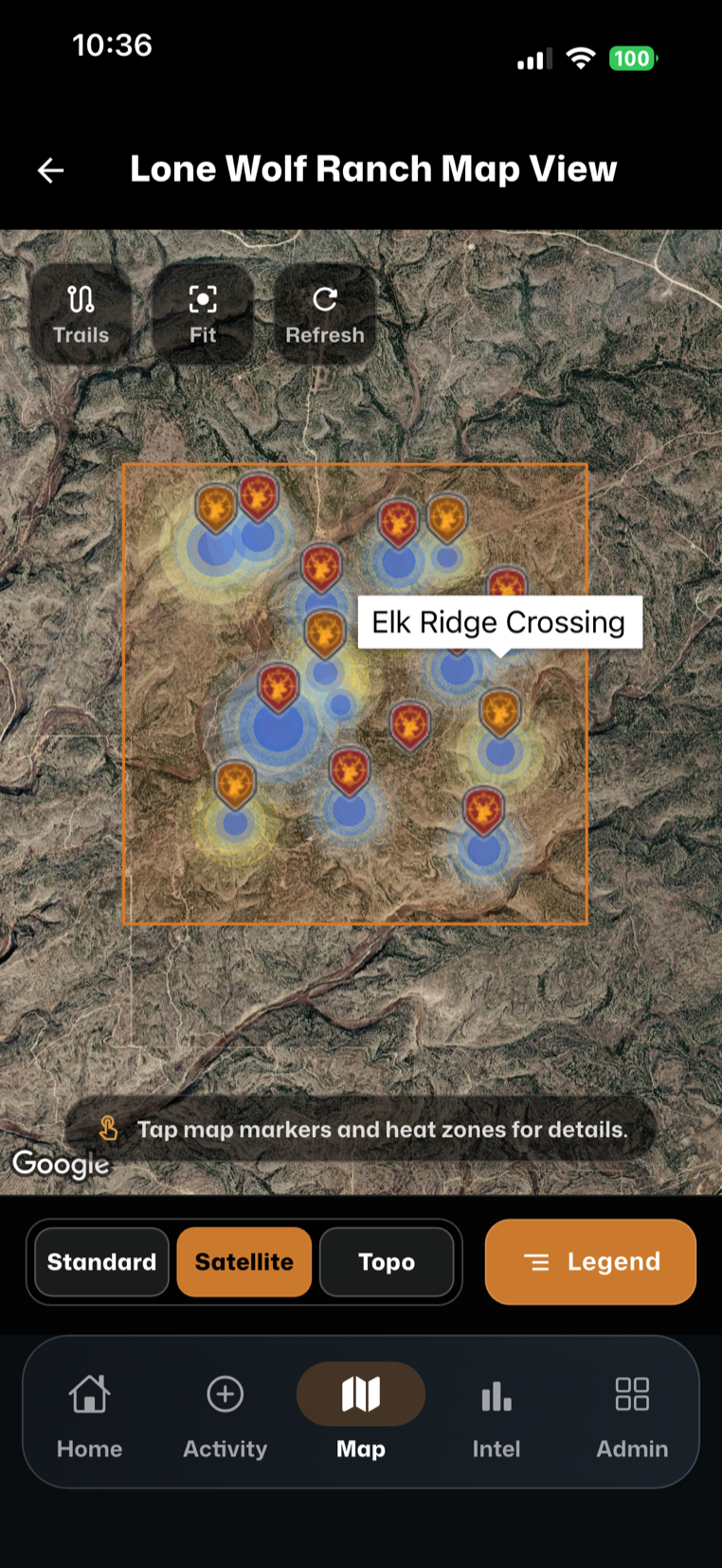
WildIndex’s Property Map can locate feeders, water, cameras and hunt sites. Sightings, harvests, camera activity and field conditions add a dated history around those places. If detections fall at a feeder, a manager can examine deployment dates, nearby sightings, a newly available plot or mast, and changes in hunter activity before concluding that deer disappeared.
The workflow is a management problem, the records needed to examine it, and a decision to investigate. WildIndex keeps those observations attached to one property and available to authorized users across seasons. Digital records help identify associations worth investigating; they do not automatically establish cause and effect. A field check and sound habitat advice still matter.
The site-selection guide shows how food evidence joins wind, access and safety when planning a hunt. The harvest-goals guide explains why supplemental food does not by itself determine a sustainable quota.
Practical questions
Common questions
Are food plots better than feeders?
They serve different purposes. A plot can provide seasonal forage; a feeder can attract deer and may supply energy or nutrients depending on its contents. Start with native habitat and the property’s actual nutritional gap.
Is corn nutritious for deer?
Corn supplies energy but is not a balanced deer diet or complete supplement by itself. Its role as bait or feed should be kept separate from a planned nutrition program.
What do deer eat besides food plots?
Deer use native forbs, leafy browse, shrubs, vines, mast and other available plants, with diets changing by season and region.
How large should a food plot be?
There is no universal size. Soil, sunlight, browse pressure, objective and the distribution of plots across the property matter; use regional extension guidance rather than an acreage rule alone.
Can food plots improve antler growth?
Better nutrition may contribute to body and antler development when nutrition is limiting, but age, genetics, density, habitat and weather also matter. One plot or one season’s antlers cannot prove an effect.
Why did deer stop visiting my feeder?
A new natural food source, changed timing, disturbance, camera failure or shifted movement are all possible. Check the feeder, camera effort and other property observations before inferring fewer deer.
References
Sources & Further Reading
This article draws on peer-reviewed wildlife research, university extension guidance, and agency management resources. Findings from one region or study design may not apply unchanged to another property.
- Mississippi State University Extension. A Guide to Common Native Deer Forages in Mississippi and the Southeast Extension Publication 3618.
- Mississippi State University Extension. Food Plots
- Mississippi State University Extension. Wildlife Food Plot Planting Guide for the Southeast
- Ken Cearley, Texas A&M AgriLife Extension. Feeding Deer: Supplementing or Baiting?
- U.S. Geological Survey. Alternative Feeding Strategies and Potential Disease Transmission in Wisconsin White-tailed Deer
- W. J. McShea and G. Schwede. Variable Acorn Crops: Responses of White-Tailed Deer and Other Mast Consumers Journal of Mammalogy 74(4):999–1006. 1993. doi:10.2307/1382439.
- Mississippi State University Extension. The Role of Genetics and Nutrition in Deer Management Extension Publication 3013.
WildIndex in the field
Put food sources in the context of the whole property.
Keep mapped features and field observations together so changes prompt better questions about habitat and deer use.