


WildIndex Intelligence / Deer Management
How to Set Deer Harvest Goals for a Hunting Property
A useful harvest target begins with the property’s objective and the evidence available to support a decision.
By WildIndex Editorial Team · Published October 21, 2026 · Last reviewed October 21, 2026
“How many does should we take?” sounds like a request for one number. For a managed property, it is the end of a longer inquiry: What outcome is wanted? How many deer are likely using the landscape? How many fawns survive into the next age class? What condition is the forage in? What did the property harvest in prior years, and how much effort produced that harvest? Local law, neighboring land and a biologist’s recommendation also matter. A fixed deer-per-acre rule or universal doe percentage hides most of those inputs. The objective here is a defensible planning process, including a clear account of what remains unknown.
01 / Purpose
Start with the outcome the property is trying to achieve
Possible objectives include keeping deer numbers near the present level, reducing browsing pressure, improving the balance between deer and available forage, increasing opportunities to encounter older bucks, limiting crop damage, or providing a predictable recreational harvest. These goals can overlap but are not identical. A property that wants fewer deer needs a different harvest discussion from one trying to maintain a stable herd during drought.
TPWD’s deer-management plan guidance puts goals, habitat, surveys, harvest strategy and records in one planning cycle. It says specific annual harvest recommendations should be based on current census information rather than locked into a long-term plan. That is a useful discipline even outside Texas: write the multi-year objective, then revisit the annual take using the evidence available that year.
Make the objective observable. “Better deer” is too vague to evaluate. “Reduce heavily browsed areas while retaining hunting opportunity” gives a manager something to monitor through vegetation observations, harvest composition and hunter effort. State whose goals matter—landowner, lease members, agricultural operation or conservation program—and how tradeoffs will be decided.
Finally, separate the management objective from the legal permission to hunt. An internal target can be stricter than a county rule but can never authorize more than the applicable regulation. The property’s administrator should communicate both clearly.
02 / What counts mean
Harvest data are not the same thing as population size
A harvest total is a count of animals taken, not a count of animals present. It depends on hunter numbers, days afield, access, weather, deer behavior, regulations and selectivity. A lower buck harvest might mean fewer bucks; it could also mean that hunters passed more young animals, hunted less or encountered different conditions. The deer harvest-tracking guide explains how to keep those contextual fields.
Sightings are also conditioned by observation effort. Twenty deer seen during a week of ten long hunts cannot be compared directly with twenty deer seen during two short hunts. Cameras add a different sample: detections at the places and times devices operated. Parsons and colleagues found that camera detection metrics cannot simply be treated as local deer density. A structured camera survey can provide stronger population-characteristic information, but the design and assumptions must match the property and question.
When a target requires a reliable population estimate, consult the appropriate agency or wildlife professional and use a defensible survey. A manager can still make prudent decisions when data are incomplete, but should label the estimate, its method and uncertainty. Confidence should rise with converging evidence, not with a large number of unstandardized photographs.
03 / Population change
Why antlerless harvest often matters most to population trajectory
Adult females are the reproductive segment of a deer population, so their survival and harvest can strongly affect future numbers. TPWD’s harvest-strategy guidance discusses antlerless take as a way to align deer numbers with available range. Mississippi State Extension similarly connects density management with habitat and nutrition and recommends working with a biologist to determine an appropriate harvest rate.
That principle does not translate into “every property should shoot a fixed percentage of does.” If fawn recruitment is low, the same doe take can lead to a different outcome than in a year with high recruitment. If deer move freely across several ownerships, one tract’s effort may be diluted or amplified by neighboring harvest. A small property may have little ability to determine population trajectory alone. Objectives and survey scale have to match the biological landscape.
Before setting an antlerless target, consider a current estimate of deer numbers or trend, age and sex composition, fawn recruitment, habitat browsing, prior doe harvest and hunting effort. A biologist may recommend a range or adaptive target rather than a rigid figure. During the season, keep a running count and review whether conditions or new evidence justify a management change within legal limits.
04 / Age structure
Buck harvest should follow the property’s age-structure objective
A property seeking more encounters with older bucks may choose to pass younger legal bucks, limit buck harvest, or focus on habitat and reduced disturbance. Those are management choices with costs and uncertainty. The outcome depends on survival beyond the property boundary as well as what hunters do internally. A narrow stand-level observation of antler size is not a full age-structure survey.
Harvest records can show the ages or age estimates of bucks taken, but those estimates must be labeled by method. Body and tooth-based estimates can carry error; antler size is influenced by age, nutrition and genetics and is not a simple certificate of maturity. Mississippi State Extension’s genetics-and-nutrition guidance emphasizes density and habitat as practical management levers rather than promising that selective culling will reshape a free-ranging herd’s genetics.
Write a harvest policy in terms hunters can apply and administrators can review. If the objective is to retain more older males, describe acceptable criteria, exceptions, and how the property will learn whether the policy changed the age structure of harvests. Do not present a county antler restriction as a biological prescription: it is a legal rule that must be followed independently.
05 / New deer
Recruitment changes what a harvest can sustain
Fawn recruitment describes young deer surviving into the population, not merely the number born. It varies with local habitat, weather, predation, nutrition and the timing and method of observation. A high doe count with few surviving fawns may support a different harvest plan from a similar doe count with strong recruitment. The useful question is not “How many fawns did one camera show?” but “What does a consistent survey indicate about the ratio of young to adults across this area?”
Mississippi State Extension’s structured camera-survey guidance explains how a defined sampling procedure can estimate population characteristics. Informal cameras are still useful for identifying questions, but their placement around feeders or trails can distort which age classes are detected. Keep site, deployment period and review method attached to every comparison.
Recruitment should be considered with adult survival and harvest. A single unusual season need not trigger a permanent rule, while repeated low recruitment deserves attention. A manager should document the method used and seek regional biological context rather than borrowing a fawn ratio from a neighboring state.
06 / Carrying capacity
Judge deer numbers against habitat, not a universal acreage formula
Habitat capacity is not fixed at a certain number of deer per hundred acres. Soil, rainfall, vegetation, livestock use, crops, management history and seasonal stress differ. TPWD’s range guidance gives Texas examples that vary substantially by ecological setting. The lesson is variability, not a quota to import to a new tract.
Look for evidence of browsing pressure on preferred native plants, regeneration of seedlings, condition of the understory, and the availability of cover and seasonal forage. A property may have abundant visible deer yet still carry them within its habitat’s productive capacity; another may have fewer deer but highly stressed forage after drought. Mississippi State Extension describes native forage as the foundation of deer nutrition, with food plots as supplements rather than replacements for landscape-scale habitat.
Habitat work and harvest are related. Reducing numbers without addressing degraded vegetation may not achieve the desired condition; adding food plots while ignoring excessive browsing may only concentrate observations. The food-source guide explains how to evaluate native forage, plots and feeders as different tools.
07 / Evidence package
Assemble the records before agreeing on a target
A useful annual review gathers prior harvests by sex and credible age class; dates, sites and hunter effort; structured survey results when available; sightings including zero-sighting hunts; recruitment indicators; consistent body weights or condition notes; camera deployment history; and habitat observations. Agency or biologist recommendations belong in the same folder. Each input should have a date, method and geography.
Do not give all records equal weight. A designed property-wide survey addresses a different question from a trail camera at one feeder. A measured weight is stronger than a remembered estimate. A run of harvests with recorded hunter-days is more interpretable than a trophy-room photo collection. Gaps should be named, not filled with confidence.
At the meeting, write an evidence statement: what is known, what is inferred, what is uncertain, and what additional observation would change the plan. That statement makes an annual target reviewable. The property-records guide gives a minimum field list, and the camera guide covers sampling limits.
Assign a person to audit the data before the meeting. Duplicate camera events, a harvest entered under the wrong site, and missing zero-sighting hunts can make a confident chart out of a weak record. Correct factual errors while preserving the original entry when possible. If an estimate is too uncertain for a quota decision, say so plainly and seek a better survey rather than adding decimal places to the calculation.
08 / Local context
Why one property should not copy another property’s quota
Two tracts of the same acreage may differ in available forage, annual rainfall, neighboring land use, deer movement across fences, hunting access and management goals. The proportion of land actually hunted can differ as much as the area on the deed. A quota copied from a nearby lease may also be based on a different survey year or a different definition of “doe.”
Even within one property, a fixed quota can become stale. A drought, land clearing, a changed lease boundary or a new source of agricultural food can shift the balance. A manager should revisit the target annually and during the season when material conditions change. That is adaptive management: act from a stated hypothesis, record what happened, and adjust when evidence warrants it.
For small properties, coordination with neighbors may provide more meaningful population context than ever more precise arithmetic on one tract’s sightings. Where professional guidance is available, bring the property records and questions to that discussion. The property-management guide describes the larger planning cycle that surrounds harvest decisions.
09 / How WildIndex helps
Use a shared record to review the harvest plan as the season unfolds
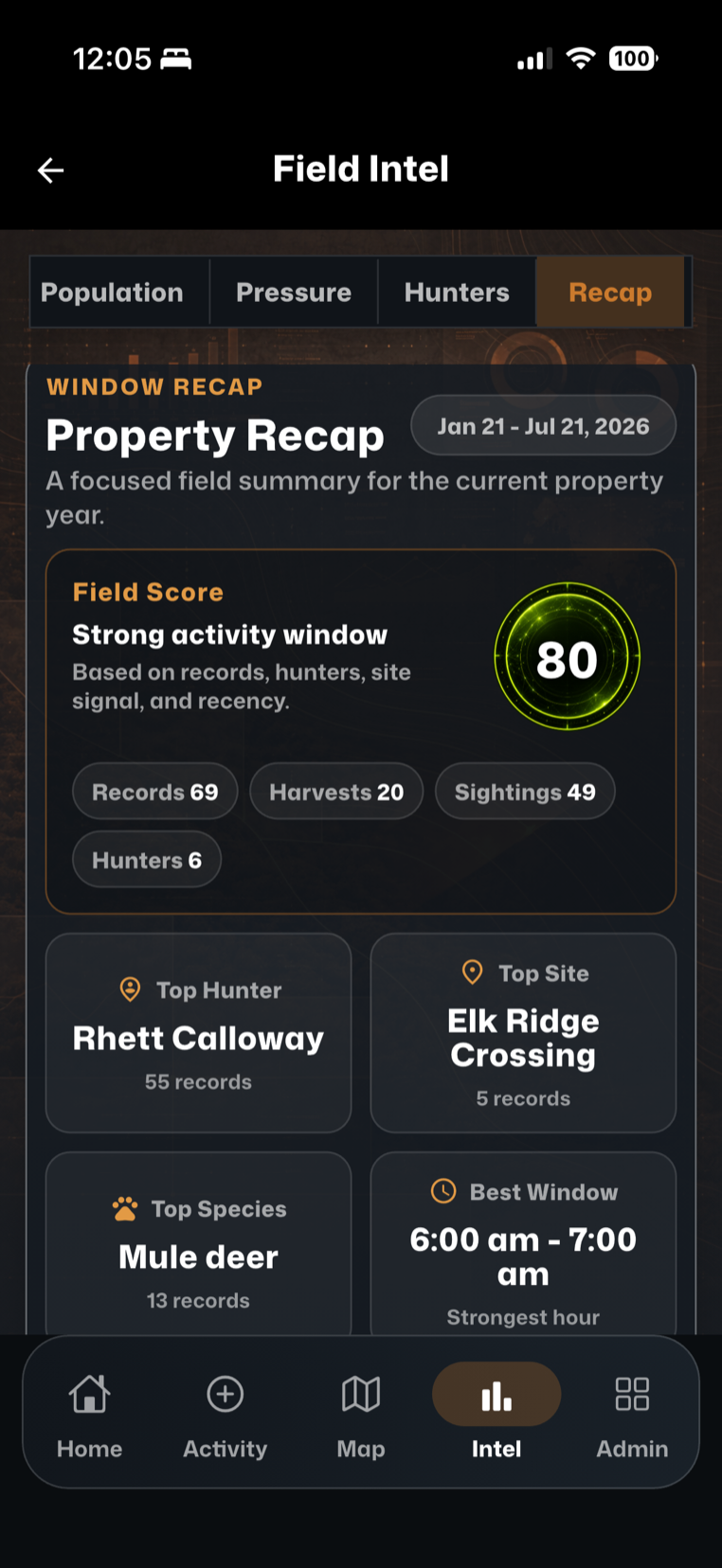
WildIndex can organize multi-year harvests, species and sex classifications, credible age estimates, measurements, sightings, mapped sites, camera activity and hunter participation. A manager can compare seasons with more context and see whether the group is approaching its agreed target. The property recap below illustrates a real WildIndex view of shared records.
The management problem is deciding from selective memory: a few memorable bucks, uncounted quiet hunts and harvest totals kept in separate phones. A shared digital history reduces that fragmentation. It improves the evidence available to a manager or wildlife biologist; it does not calculate a biologically correct quota from incomplete data. The manager still needs a defensible estimate, habitat context and an objective.
Use the record to document decisions as well as observations. If the target changes, note when, why and who approved the change. At season end, compare the outcome with the objective and identify which uncertainty should be addressed before next season. This is where a persistent property history has more value than a single year’s count.
Practical questions
Common questions
How many does should I harvest?
There is no defensible universal number. The appropriate antlerless harvest depends on the objective, population and recruitment evidence, habitat, prior harvest, effort and local regulations. Seek a property-specific recommendation when possible.
How many deer per acre is too many?
No single density fits every habitat or year. Evaluate browsing, forage condition, rainfall and survey evidence with regional wildlife expertise rather than copying an acreage formula.
Should every property harvest does?
No. Antlerless harvest can be a strong population-management tool, but whether and how much to use it depends on the desired population trajectory and current evidence.
Does shooting older bucks improve herd genetics?
It should not be treated as a simple genetics intervention in a free-ranging herd. Age, nutrition and genetics all affect antlers; property objectives and habitat matter more than a claim that one cull changes the gene pool.
What data should I review before setting goals?
Review recent harvests with hunter effort, a credible population or trend estimate, recruitment, body condition, habitat observations, camera-survey design and any agency or biologist recommendation.
Can trail cameras set a doe quota?
Casual photo counts cannot. A structured survey may contribute population-characteristic information, but the quota still requires objectives, habitat and recruitment context.
References
Sources & Further Reading
This article draws on TPWD management guidance, Mississippi State University Extension and camera-survey research. A harvest target for a particular property should be reviewed with an agency or qualified wildlife professional when population estimates are consequential.
- Texas Parks and Wildlife Department. Developing a Deer Management Plan TPWD technical guidance.
- Fielding Harwell, Texas Parks and Wildlife Department. Harvest: An Essential Strategy for White-tailed Deer Management TPWD technical guidance. 1994.
- Mississippi State University Extension. The Role of Genetics and Nutrition in Deer Management Extension Publication 3013.
- Raymond Sims and Jim Dillard, Texas Parks and Wildlife Department. White-tailed Deer Harvest Records TPWD technical guidance.
- Mississippi State University Extension. Conducting Camera Surveys to Estimate Population Characteristics of White-Tailed Deer
- A. W. Parsons et al.. Do occupancy or detection rates from camera traps reflect deer density? Journal of Mammalogy 98(6):1547–1557. 2017. doi:10.1093/jmammal/gyx128.
- Mississippi State University Extension. A Guide to Common Native Deer Forages in Mississippi and the Southeast Extension Publication 3618.
WildIndex in the field
Set the goal from the property record, not from memory.
Keep harvests, sightings and hunter effort together so annual decisions begin with a fuller account of the season.