


WildIndex Intelligence / Deer management
Deer Harvest Tracking: What Land Managers Should Record and Why It Matters
A harvest history is most useful when it preserves the animal, hunter, place, timing, and effort behind each entry.
By WildIndex Editorial Team · Last reviewed October 21, 2026
A list of harvested deer answers one question: what was taken. A management record should also show which deer were taken, where, when, by whom, and under how much hunting effort. Over several seasons, those details help a landowner examine harvest composition and ask whether the results align with the property’s goals. They do not, by themselves, count the living herd. TPWD advises combining harvest records with population surveys and habitat information when evaluating a deer program. See TPWD harvest-record guidance.
01 / Field record
What should be recorded for every deer?
Begin with a short set of fields every hunter can complete. Add biological measurements only when the property has a consistent method and a reason to use them. A nearly complete simple record is more valuable than an elaborate form that most hunters abandon.
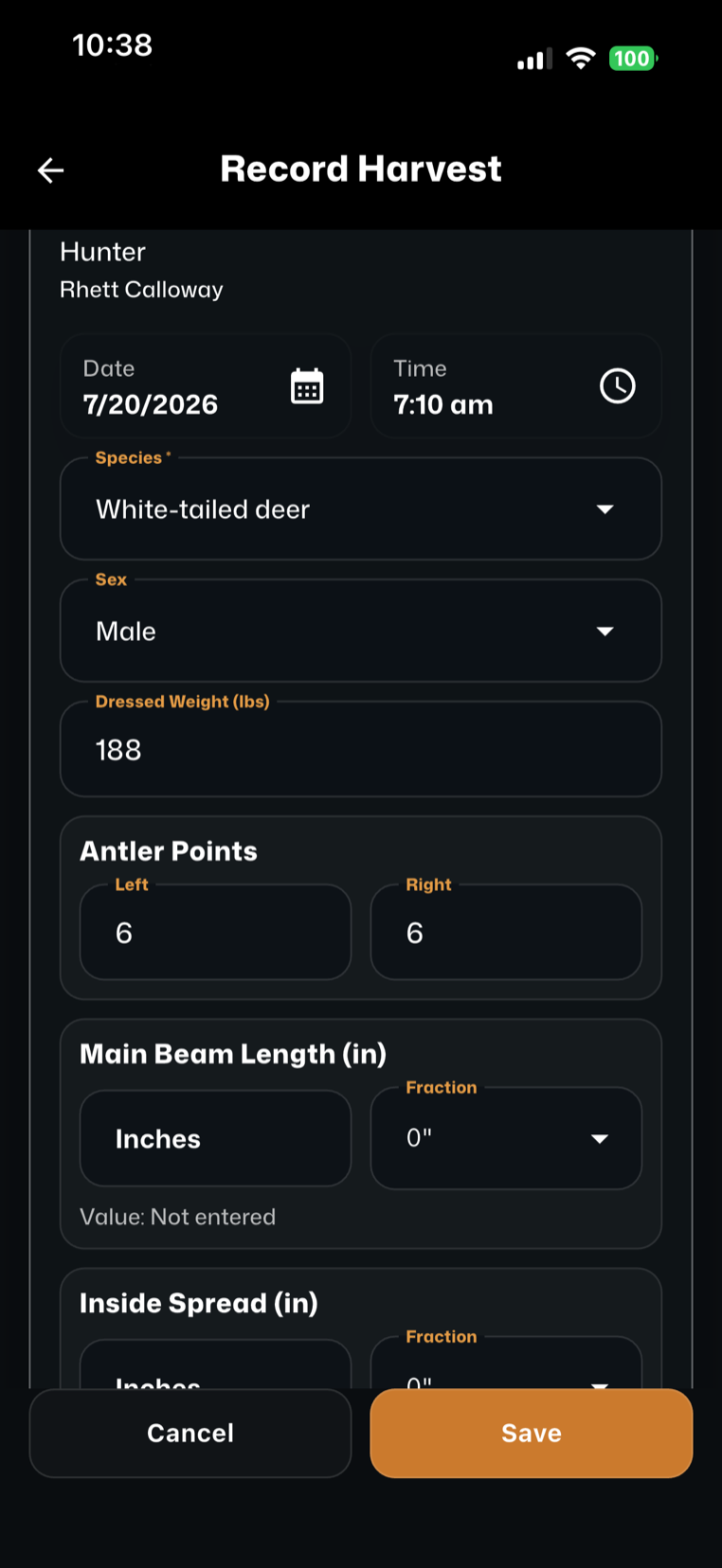
TPWD specifically recommends age, field-dressed weight and buck antler measurements for a managed white-tailed deer herd, with date, location and body condition as useful additional context. It also recommends linking a collected jawbone to the individual record when age will be assessed later. Read the TPWD guidance. Record an estimate as an estimate; avoid treating an uncertain field age as a laboratory-grade measurement.
02 / Denominator
Harvest totals need hunting context
Twenty harvested deer can represent very different seasons. Four hunters making 20 hunts had a different opportunity to encounter deer than 20 hunters making 100 hunts. Record days or outings hunted, hunter participation, site use, and whether a hunt produced no harvest. Then a manager can compare harvest per outing as well as total harvest. The result is an effort-adjusted description of the hunting record, not a deer-density estimate.
Effort is only part of the context. Access may change, stands may move, crops or mast may shift deer movement, and weather or season timing may alter the odds of an encounter. If a property opened a new pasture or concentrated hunters near one road, a year-over-year difference in harvest may reflect those choices. TPWD’s management-plan guidance asks managers to retain hunting history along with harvest and habitat history for this reason.
03 / Interpretation
Look at composition, not just totals
Break the season down by buck and antlerless harvest, estimated age class, site, and period of the season. A property seeking a different age structure may review the ages of harvested bucks; one managing browsing pressure may focus on antlerless harvest alongside habitat and survey information. Compare like with like: field-dressed weights should be measured the same way, and antler or age summaries should be grouped by relevant age class rather than pooled indiscriminately. TPWD’s South Texas harvest-data guidance describes how annual age, weight and antler data can help evaluate herd-quality goals.
There is no universal buck-to-doe harvest ratio for every tract. Appropriate harvest depends on goals, habitat, population evidence, neighboring land, and local rules. The harvest-goals guide explains how to set an annual objective from those inputs. The sex ratio in the harvest describes what hunters selected; it is not automatically the sex ratio of all deer on the property. Likewise, a cluster of harvest pins can identify where hunters succeeded, but it also reflects where hunters spent time.
TPWD describes harvest measurements as one part of a larger picture that includes population and browse surveys. A drop in average weight may justify a closer look at habitat or herd condition; it does not identify a cause on its own. See TPWD’s Pineywoods management example.
04 / Data quality
Why does consistency across seasons matter?
Choose definitions before opening day: whether time means shot time or entry time; whether weight is field-dressed; how hunt sites are named; what counts as an outing; and who may revise an age estimate. Keep those definitions with the record. If a field changes, note when it changed instead of silently treating old and new values as equivalent.
A useful annual comparison starts with the same season window and the same property boundary. Flag missing measurements and unusual circumstances. A new camera network, different hunter access, or a major habitat treatment can be more informative than a simple line chart of totals. The aim is to make the next management question clearer, not to manufacture a trend from a small or inconsistent sample.
05 / Analysis
Which harvest summaries are worth making?
Start with a count by species and sex, then show those counts by week and by hunt site. Add the number of outings in the same periods. This reveals whether a busy week reflects more success per outing or simply more people hunting. When enough age estimates are credible, group harvests by broad age class and show how many records have unknown age. Do not hide the unknowns; they show the limits of the comparison.
A buck-to-antlerless harvest ratio is easy to calculate but easy to misread. If a property takes six bucks and four antlerless deer, the harvest ratio is 1.5 bucks per antlerless deer. It says nothing by itself about the sex ratio of the deer still alive. The same caution applies to harvest per site: it describes where successful hunters were, and should be read alongside the number of outings at each site.
For body measurements, compare deer of similar sex and estimated age, using the same scale and field-dressing convention. A one-year change among only a few animals may be noise. Display the number of animals behind each average and retain the individual records. TPWD’s harvest-record guidance emphasizes that weight and antler measurements are closely related to age; interpretation without that context can mislead.
Finish the summary with plain-language exceptions: a stand was moved, a pasture was unavailable, or the property had unusually little hunter participation. Those notes explain why a chart may not be comparable with last season. The most useful report is one a manager can question and revise.
06 / Property workflow
How WildIndex supports the record
WildIndex gives authorized hunters a mobile harvest-entry workflow tied to the property. A hunter can add the animal details, date, field location and photos, while property administrators can review records across participants. The shared history can be considered alongside sightings, mapped hunt sites and other activity instead of reconstructed from group texts and individual photo libraries.
The manager should still check entries for missing information and reconcile any required official log. WildIndex organizes the observations; the property decides how to interpret them. Texas hunters should review the tagging and reporting guide; MLDP properties also need the daily harvest-log guide. The broader property-management guide explains how hunter activity and site records fit together.
07 / Annual review
Questions to ask at season’s end
- How many deer were recorded, and are any entries missing or duplicated?
- What was the sex and estimated age composition of the harvest?
- Which sites and dates produced harvests, and where was hunting effort concentrated?
- How many hunter outings produced those records, including unsuccessful outings?
- Were weights, age estimates and antler measurements collected consistently?
- How do the results compare with prior seasons, survey evidence, habitat conditions and the property’s stated goals?
Can harvest records estimate herd size?
No. Harvest is influenced by hunter effort, access, selectivity and regulations. It is a record of removals, not a direct census. Use an appropriate survey design and professional guidance when population estimates are needed.
References
Sources & Further Reading
- Raymond Sims and Jim Dillard, Texas Parks and Wildlife Department. White-tailed Deer Harvest Records TPWD technical guidance.
- Texas Parks and Wildlife Department. Developing a Deer Management Plan TPWD technical guidance.
- Texas Parks and Wildlife Department. South Texas Plains White-tailed Deer Harvest Data
- Texas Parks and Wildlife Department. Pineywoods White-tailed Deer Management
- Mississippi State University Extension. Conducting Camera Surveys to Estimate Population Characteristics of White-Tailed Deer
WildIndex in the field
Build your property’s harvest record.
Give each authorized hunter the same entry workflow and keep the season’s records together for review.