


WildIndex Intelligence / Texas Regulations
Texas Deer Tagging and Harvest Reporting: What Hunters and Property Managers Need to Know
Tagging, state reporting and the property’s management log serve different purposes. Know which steps apply to the hunt.
By WildIndex Editorial Team · Published October 21, 2026 · Last reviewed for the 2026–27 Texas hunting season on October 21, 2026
A Texas deer harvest creates several records with different jobs. The hunter needs a valid license and lawful tag or permit, must follow applicable proof-of-sex and carcass rules, and may have a mandatory state-reporting obligation. An MLDP property may have additional tag and program requirements. Separately, the property manager benefits from a shared history of who harvested what, where and when. Completing a private app entry cannot satisfy a TPWD requirement; completing a TPWD report does not automatically preserve every detail the property wants for management.
Tagging and reporting requirements can change. Verify the current TPWD tagging instructions, after-harvest rules and your county listing before hunting.
01 / Terms
Tagging and harvest reporting are related but different
A tag or permit documents a legal animal taken by the hunter under an applicable license or program. Mandatory harvest reporting sends specified harvest information to TPWD when a rule requires it. A paper hunting-license tag and a digital tag use different procedures. A property’s own harvest record is a third layer, maintained for management rather than as the state’s legal transaction.
The distinction has a current Texas exception worth understanding. TPWD states that executing a digital tag in Texas Hunt & Fish serves as completion of mandatory harvest reporting for deer in applicable counties. A hunter using a standard paper hunting-license tag in a mandatory-reporting county must make the separate report within the required period. Do not assume that a photograph of a tag, a message to the landowner or a WildIndex entry is a TPWD report.
Which path applies begins before the hunt: printed or fully digital license, county, deer class, season, and whether an MLDP tag or other permit will be used. For the broader legal context, see the 2026–27 Texas deer regulations guide.
02 / Preparation
Verify license, county, tag method and property status first
TPWD’s county listing identifies the applicable season, bag and antler rules, and local provisions. Confirm the exact tract, including any split-county geography. Then confirm the hunter’s license and available tag type. A person who selected a printed license must use the paper license tags mailed for that license; choosing a digital license means following the digital tagging process. TPWD’s digital-license page emphasizes that merely buying online does not make a license digital.
Digital license holders should connect the license to Texas Hunt & Fish, confirm the tag inventory and charge the device before going to the field. TPWD says digital tags are available through that app. A paper-license holder should have the physical license and know which tag is valid for the intended deer. Neither license format relaxes county limits or special restrictions.
Determine whether the property is enrolled in MLDP and whether the animal class must be taken under an issued MLDP tag. The landowner or designated agent should give hunters the relevant property instructions. Also check for a CWD zone or special processing requirements. The preseason property checklist makes these assignments explicit before opening day.
03 / After harvest
For a printed license, follow TPWD’s paper-tag and license-log sequence
Under TPWD’s current paper-tag instructions, the hunter uses the appropriate tag from their own printed license, completes it legibly with the required property and county information, and notches the month and date. TPWD directs the hunter to complete the tag immediately after harvest and before the deer is field-dressed or moved, then attach it immediately. Read the tag description: different numbered tags have different permitted uses.
For a white-tailed deer taken with a hunting-license tag, TPWD also requires the harvest log on the back of the paper license to be completed as directed. The agency’s tagging page explains an exception to that license-log requirement for deer taken under an MLDP tag, a TPWD Special Drawn Public Hunt permit, or Big Time Texas Hunt. This distinction concerns the paper license log; it is not permission to omit any MLDP or other required record.
TPWD says the appropriate tag or permit remains attached through transport until the applicable final-destination and quartering conditions are met. The hunter should read the current after-harvest page before field processing, particularly if the head and carcass will be separated. These details matter more than a camp habit remembered from a prior year.
04 / App workflow
Digital tags require the TPWD app and physical carcass documentation
For a fully digital license, TPWD says the hunter must execute the appropriate digital tag immediately upon take in Texas Hunt & Fish. The app should be downloaded and the license connected before leaving for the hunt, even where service is unreliable. A digital tag is not an image of a paper tag and cannot be created by a property-management app.
Digital tagging still has a physical component. TPWD requires a durable handwritten document attached to the deer carcass. If the submission succeeds with service, write the confirmation number on durable material and keep it attached and legible until tagging requirements cease. If the app saves the harvest as unsubmitted because service is unavailable, TPWD directs the hunter to attach durable material with their name, license customer number, and harvest date and time, then submit when service returns and add the confirmation number. The precise current directions are on TPWD’s digital-tagging page.
Execution of a digital tag fulfills mandatory harvest reporting in applicable counties, according to TPWD. Hunters should still confirm the app submission and sync status; an unsubmitted record is not the same as a completed state report. Where the agency revises its process, follow the agency’s version, not this summary.
05 / State submission
Mandatory reporting depends on the county and deer class
TPWD’s 2026–27 white-tailed deer page requires a license-tagged harvest to be reported within 24 hours in specified counties. Collin, Dallas, Grayson and Rockwall require reporting of both buck and antlerless white-tailed deer taken under a hunting-license tag. TPWD also lists a separate group of counties or defined county portions where the requirement applies to antlerless deer. Rather than relying on a copied list, check the current TPWD page and county entry for the property.
For a paper-tagged deer subject to the rule, TPWD provides the Texas Hunt & Fish app or online reporting path. For a digital license, executing the digital tag supplies the report in applicable counties. The reporting rule is distinct from whether the animal could lawfully be taken in the first place; an antlerless deer might be reportable in a county yet permitted only in a specified season window.
Record the state confirmation or completion status in the property’s administrative workflow if appropriate, while protecting account details. The hunter remains responsible for the official submission. If a county or app status is unclear, consult TPWD before treating the harvest as fully processed.
06 / Transport
Do not overlook proof of sex, transport and CWD-zone rules
Tagging is not the only after-harvest requirement. TPWD’s proof-of-sex page specifies what must accompany a deer until the relevant final destination and processing condition is met. Requirements differ depending on the animal and document used. TPWD’s after-harvest page also describes how the tag or permit travels with the carcass and when a Wildlife Resource Document is needed if parts are separated or transferred.
Chronic wasting disease controls are a separate check. TPWD says that in zones with mandatory testing, an intact, unfrozen head must be presented at a designated check station within 48 hours. The agency warns that zones and additional rules may change. Review the current map and instructions before processing a deer from an affected area; a general tagging checklist should not be assumed to cover CWD requirements.
These steps are best handled with a field procedure that names the responsible hunter and identifies the TPWD page to consult. A property admin can make the information easy to find, but an app cannot inspect a carcass or guarantee compliance.
07 / Program tags
MLDP tags follow the enrolled property’s program conditions
On an enrolled property, an issued MLDP tag may be required for the particular sex of deer. The landowner or designated agent provides the tag under the program. Do not use ordinary paper-license or digital-license assumptions when a program tag controls the harvest. The hunter still needs the applicable license and must follow current TPWD instructions for the program and tract.
The MLDP daily property log and program reporting are separate from a manager’s general harvest notes. The Texas MLDP harvest-log guide covers that workflow in detail. The property should keep its current issued tags, enrollment option, authorization and official log process visible to every hunter before the first hunt.
08 / Management history
The regulatory record and the property record answer different questions
TPWD’s tag and report answer what the state requires for a legal harvest. A property record can answer what the manager needs to know later: hunter, date and time, species, sex, credible age estimate, location, photograph, weight or measurements where useful, and how the harvest fits the season objective. Include the hunt session and site so the record is interpreted with effort and access context.
Regulatory reporting answers what the state requires. A property record answers what the manager needs to know about the season. Both can be complete without being identical. A state confirmation number does not explain a stand’s history; a detailed trophy photograph does not prove state reporting occurred. The harvest-tracking guide explains how to compare harvest records without treating totals as a census.
Shared property records matter when several people hunt. Without them, an admin may reconstruct harvest activity from texts, photographs, physical logs and phone calls. A timely common record allows the group to see progress toward its own goals and correct missing details while the event is fresh. The property-records article sets out the complete deer-season dataset.
09 / How WildIndex helps
Keep compliance official and the property history connected
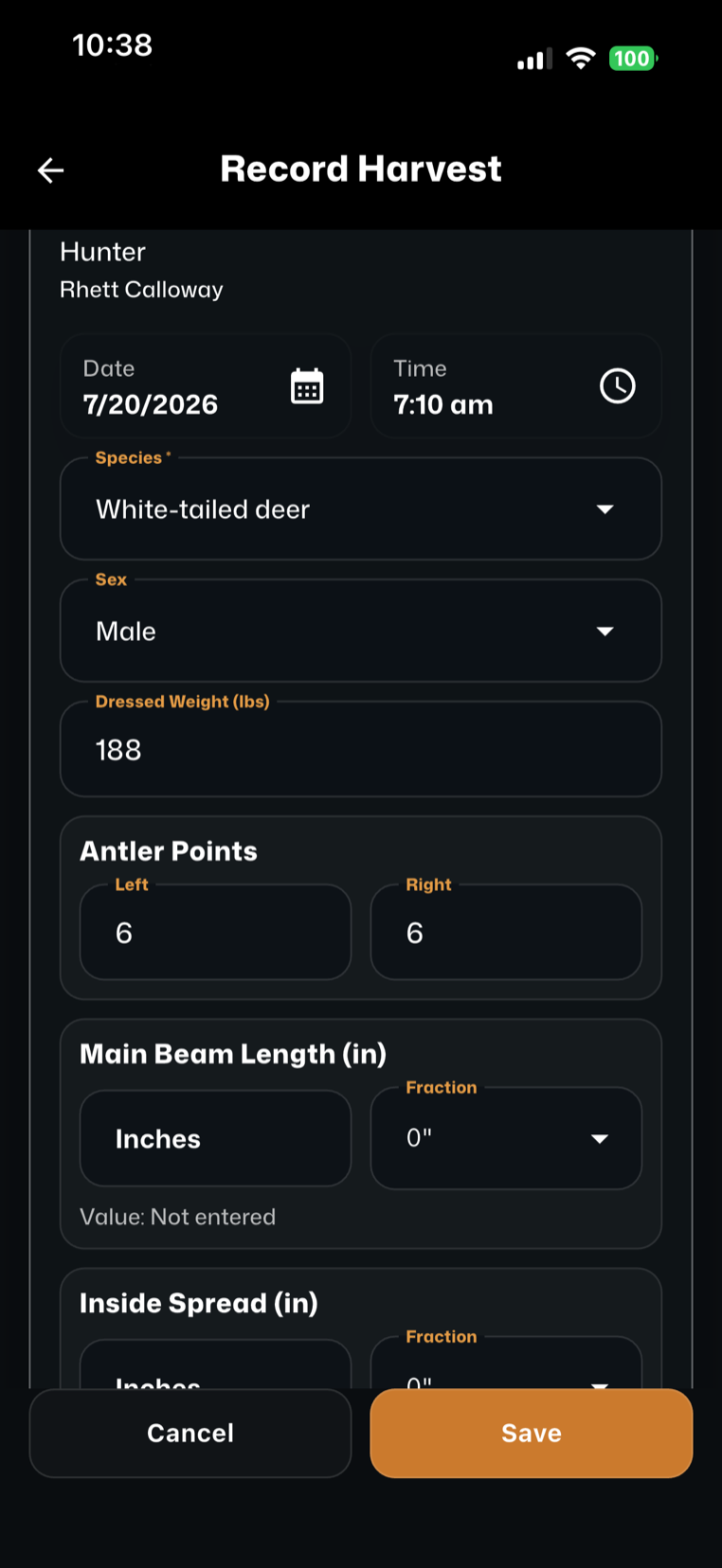
WildIndex lets authorized participants record harvests to the same property, including the hunter, animal, time, location, imagery and relevant measurements or notes. Property admins can review the season’s shared history rather than waiting for separate reports from each hunter. The actual WildIndex harvest-entry screen below illustrates the property workflow, not a TPWD form.
The management problem is reconciling several hunters’ actions after the fact. The useful record is the official tag or reporting completion plus the property’s own harvest context. WildIndex organizes the latter, giving the manager a better basis for season review. It does not issue TPWD tags, complete the Outdoor Annual check, replace state reporting, or serve as the required MLDP log unless TPWD specifically authorizes such use.
Practical questions
Common questions
When do I tag a deer in Texas?
TPWD says the appropriate paper tag or permit must be completed immediately after harvest and before the deer is field-dressed or moved. Digital-license holders must execute the digital tag immediately upon take in Texas Hunt & Fish. Follow the current TPWD instructions for the tag used.
Do I have to report every Texas deer?
No statewide rule in this guide requires every white-tailed deer to be separately reported. TPWD requires reporting of license-tagged deer in specified counties and deer classes within 24 hours; digital-tag execution fulfills that reporting in applicable counties.
Can I use a digital hunting license?
Yes, if you selected a fully digital license. TPWD says a printed license purchased online is still a paper-tag license. Digital tags are executed through Texas Hunt & Fish and require physical carcass documentation.
Are MLDP tags different?
Yes. Issued MLDP tags and the enrolled tract’s program conditions control the relevant harvest. Check the property’s current instructions and official MLDP record requirements.
Does WildIndex replace TPWD tagging or reporting?
No. WildIndex is a property-management record. Hunters must complete the applicable TPWD tag, report, proof-of-sex and program steps separately.
What should a property keep after legal reporting is complete?
Keep hunter, date and time, animal details, site, location, photograph, useful measurements, hunt context and the status of applicable official actions. Retain uncertainty rather than inventing an age or weight.
References
Sources & Further Reading
Regulatory details were checked against TPWD’s 2026–27 Outdoor Annual on October 21, 2026. Follow TPWD’s current instructions and the specific tag or permit used for the harvest.
- Texas Parks and Wildlife Department. Tagging Deer 2026–2027 Outdoor Annual.
- Texas Parks and Wildlife Department. Digital Licenses and Tagging 2026–2027 Outdoor Annual.
- Texas Parks and Wildlife Department. After Harvesting a Deer or Pronghorn Valid September 1, 2026–August 31, 2027.
- Texas Parks and Wildlife Department. White-tailed Deer: 2026–2027 Seasons & Regulations 2026–2027.
- Texas Parks and Wildlife Department. Seasons by County 2026–2027.
- Texas Parks and Wildlife Department. Proof of Sex Valid September 1, 2026–August 31, 2027.
- Texas Parks and Wildlife Department. Managed Lands Deer Program Information
WildIndex in the field
Keep compliance official. Keep the property record connected.
Use TPWD for legal tagging and reporting, and give the property a shared harvest history that lasts beyond the season.