


WildIndex Intelligence / Property Management
What Should a Hunting Property Record During Deer Season?
The useful record is the one that keeps observations, hunting effort and property decisions together across the whole season.
By WildIndex Editorial Team · Published October 21, 2026 · Last reviewed October 21, 2026
Most hunting properties already produce management information. It sits in texts, notebooks, photographs, trail-camera apps, spreadsheets and individual memory. The problem is rarely a lack of data; it is that the information lacks common fields, location and timing, or a shared home. A workable deer-season log should let a manager reconstruct what people observed, what people did, and what changed on the land. It should also make uncertainty visible. A well-kept log informs a management plan, but it is not a substitute for a formal wildlife survey or professional biological judgment.
01 / Wildlife observations
1. Sightings: record the encounter, not just the animal
For each sighting, record date, time, species, number observed, location or hunt site, observer, and a short note on behavior or direction of travel. Sex and estimated age can be useful when the observer has enough information to make a credible classification. Allow “unknown” rather than forcing certainty from a brief view. If two hunters saw the same group, note the possible duplicate before summing records.
A sighting made from a stand is conditioned by where the hunter sat, when they watched and what could be seen. A map marker shows where an observation was recorded, not the reason deer were there. A group seen beside a field at dusk may have been traveling to food, moving through cover, or responding to disturbance. Preserve the observation and the interpretation separately so later review can revise the explanation without altering the original record.
Zero-sighting hunts matter too. If only positive encounters are logged, the record cannot show how much time observers spent without seeing deer. Link sightings to the relevant hunt session where possible. The movement guide explains how food, weather and pressure can change apparent activity within a season.
02 / Management actions
2. Harvests: preserve the individual record and the context
At minimum, record harvest date and time, hunter, species, sex, location, and any required tag or reporting information. Depending on objectives, add a credible age estimate, field or dressed weight, measurements, photographs, and condition notes. State how a value was obtained: a weighed carcass is different from an estimate, and jawbone-based aging has its own uncertainty. Use consistent definitions across seasons.
Harvest records are central to many agency management programs. Texas Parks and Wildlife’s harvest-record guidance shows the value of retaining individual harvest details, and its deer-management plan guidance places harvest alongside population, habitat and goals. Specific legal reporting rules vary by jurisdiction and program; the property log should complement, not replace, required official reports.
Harvest totals should not be read as direct herd estimates. Regulations, hunter selectivity, access, weather and effort all influence what is taken. Compare harvests with the property’s objectives and the hunting that occurred. The harvest tracking guide discusses age and sex composition, effort and multi-season review in more depth. For Texas participants, the MLDP guide separates the required program log from a useful supplemental property record.
03 / Observation effort
3. Hunter effort: record the denominator most logs omit
Record who hunted, on what date, at which site, and the start and end of the hunt when available. A morning and evening sit are different observation windows; recording only “hunted Saturday” loses that distinction. Even a simple attendance and site record is better than none. Include hunts with no sightings and no harvest. Those sessions tell a manager when observation effort occurred.
Why does effort matter? Twenty sightings from ten long hunts are not the same observation history as twenty sightings from two short hunts. Neither number by itself estimates deer abundance, because visibility, site choice and animal behavior also affect encounters. But logging effort prevents the most basic misreading of raw counts. It also reveals concentration of activity at particular stands and access routes.
Participation records help operational decisions as well. Managers can see which sites are active, reduce conflicting assignments, and reconstruct whether a period of apparent low deer activity coincided with fewer hunters. The pressure article explains why human presence is part of the system being observed.
04 / Repeated sampling
4. Trail-camera activity: keep images attached to deployment effort
For each camera, retain a stable site name or map location, deployment start and end, camera type or settings when they change, whether an attractant was used where legal, and periods of failure. For reviewed images, preserve the date, time, species and any defensible classification. Note which images remain unreviewed. This turns a photo archive into a traceable observation history.
Camera-days—the number of days a functioning camera sampled a site—offer one way to describe effort. They do not remove every bias. A camera on a trail has a different chance of detecting deer than one placed systematically away from trails. Kolowski and Forrester documented placement effects, while Parsons and colleagues showed that detection rates cannot automatically be read as local density. Compare cameras only when placement, timing and settings are sufficiently similar, and explain changes that remain.
If a structured population survey is needed, follow a defensible protocol suited to the area and objective. Mississippi State University Extension describes a designed white-tailed deer camera survey; its recommendations are not a universal formula for casual property cameras. The trail-camera guide covers placement, sampling and the distinction between detections and density.
05 / The physical property
5. Property infrastructure: keep a living map of field assets
Map hunt sites, blinds, cameras, feeders where legal, water, gates, access trails, roads and major habitat work. A name like “north stand” is useful only while everyone knows which stand it means; a stable identifier and location survive personnel changes. Record installation, repair, removal and access restrictions. The history matters when a camera or stand is moved between seasons.
Separate planned infrastructure from what was actually in use. A preseason map may show a route that became impassable, a blind that needs repair, or a camera that stopped operating. A manager reviewing observations should know whether the relevant site existed and was accessible at that time. Maps and aerial images, as described in TPWD planning guidance, support property context but still need field verification.
Document safety and permission boundaries in the property’s operating process. A mapped feature does not itself establish permission to hunt or a safe shooting direction. The site-selection article connects mapped evidence to wind, access and safe use.
The preseason property checklist is a useful time to confirm which mapped assets still exist and who inspected them.
06 / Context
6. Weather and conditions: preserve context without turning it into a rule
Time, temperature, wind, precipitation and notable field conditions help explain what a hunter could observe and how a site was used. Record the conditions close to the hunt, and distinguish forecast data from what the hunter experienced at the stand. Site-level wind can differ from a regional weather station. A flooded crossing or sudden storm may affect access and time afield as much as deer behavior.
Be cautious with patterns based on a handful of hunts. In an Oklahoma GPS-collar study, Webb and colleagues reported that fine-scale weather effects on movement were inconsistent, while crepuscular activity was more consistent. The result does not mean weather never matters. It means a simple universal weather trigger should not be asserted from one property’s sightings or one study. Weather can change hunter participation and visibility, too.
Record season phase and major food changes alongside weather when relevant. Deer use can move with changing forage or mast, as documented in a Virginia acorn-crop study. A field note such as “acorns began falling in the west woods” may later be more informative than an automatically captured temperature alone.
07 / Program records
7. Compliance and administration: preserve the supporting history
Properties may need to track authorized users, hunting permissions, licenses, tags, lease rules, equipment responsibilities and program-specific records. Keep the official document or reference where the people responsible can find it, along with dates and who completed each action. Requirements differ by state, species and management program; use the current agency instructions for the property’s jurisdiction.
For an enrolled program such as Texas MLDP, the official daily log and reporting workflow remain the controlling requirements. A digital property record can help reconcile hunts and harvests, but it should not be represented as replacing the agency form. TPWD’s wildlife management plan guidance illustrates the broader need to document objectives, practices and results over time.
Administrative records are part of continuity. When a lease manager changes or a long-time hunter leaves, the property should retain its own history. Restrict sensitive personal information to authorized users and follow the organization’s retention and privacy practices.
08 / Record quality
Consistency and shared access make the dataset usable
A short form completed every hunt is often more interpretable than a long form completed only when someone sees a large buck. Agree on a small set of required fields, names for sites, definitions for age or sex categories, and a routine for reviewing missing records. Allow uncertainty rather than inviting guesses. A photograph can support a later review, but it does not repair a missing date or location.
Shared records also reduce selective memory. One hunter may remember productive weekends while another remembers quiet mornings at different sites. When authorized participants contribute to the same property, a manager can review the full set, including zero-sighting hunts and camera failures. Information stays attached to the property across seasons instead of disappearing with a phone, notebook or group chat.
Review records during the season rather than waiting until its end. Fixing a mislabeled site or missing harvest detail is easier while the event is fresh. At season close, export or archive the history according to the property’s practice, note major changes in habitat and access, and state which management questions remain unresolved.
09 / Interpretation
Ask management questions the records can actually address
Instead of asking only “How many deer did we see?”, ask how observations varied with periods of comparable hunter activity. Instead of “Which stand is best?”, ask which sites produced recurring observations under similar timing, access and conditions. Instead of “Are there fewer deer because cameras took fewer pictures?”, ask whether camera location, operating days and review status changed. Each question makes the limits of the comparison visible.
Use the record to identify where more fieldwork is needed. An apparent shift from one area to another may justify checking current food, sign and access routes. A harvest objective that depends on population or age-structure estimates may require a designed survey and a qualified wildlife professional. The property log provides context for that work and for interpreting its results; it does not create certainty by accumulating anecdotes.
Write down decisions and reasons. If a site is moved, a refuge is created, or harvest criteria change, record the date, objective and evidence considered. A later manager can then assess whether observed outcomes fit the original expectation or whether other changes likely mattered.
10 / How WildIndex helps
Build one property record with WildIndex
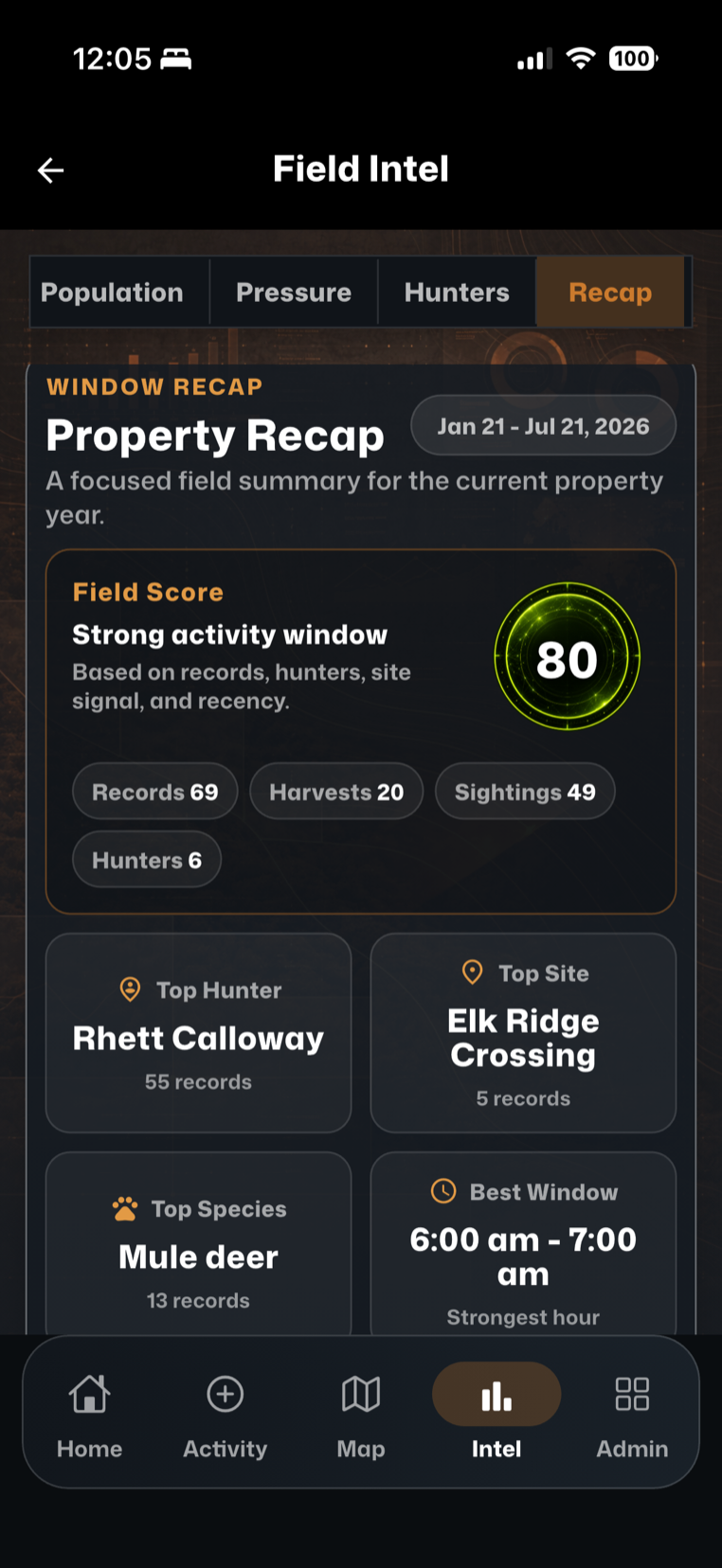
WildIndex connects sightings, harvests, mapped hunt sites, camera activity and hunter participation. Today’s Hunt gives field context; Active Hunts helps authorized users see current property activity; Field Intel and property recaps help a manager review what has accumulated. Trophy Rooms preserve individual harvest context, while WildIndex Web makes the shared property record accessible beyond one hunter’s device.
The management problem is fragmentation: a sighting in a text thread, a camera image in another service, a harvest in a spreadsheet and a stand name known only to one person. In WildIndex, authorized participants can record observations against the same property and review them as a common history. The benefit is easier comparison and less reconstruction after the season, provided the records are entered consistently.
Digital tools are most useful when they make good recordkeeping easier—not when they pretend to replace management judgment. WildIndex cannot determine deer abundance from casual photos or tell a manager exactly where an animal will be. It can provide a stronger evidence base for questions that already matter to the property. The property-management guide sets out the annual planning cycle that can use those records.
Practical questions
Common questions
What information should be recorded for every deer sighting?
Record date, time, species, number seen, observer and location or site. Add sex, age estimate and behavior only when the observation supports them; allow unknown values.
What records should a hunting lease or club keep?
Keep hunt participation and site use, sightings including zero-sighting hunts, harvest details, camera deployment, mapped assets, safety and access information, and any required program or lease documents.
Can harvest totals show whether a deer herd is growing?
Not by themselves. Harvest totals depend on regulations, effort, hunter choice and opportunity as well as deer abundance. Use appropriate survey methods for stronger population conclusions.
Should trail-camera pictures be counted as individual deer?
Only with great caution. Repeated detections, variable placement and differing camera effort make raw photo totals unsuitable as a direct herd count. A designed protocol is needed for survey inference.
Is a spreadsheet enough for hunting property records?
A consistent, shared spreadsheet can be useful if the group maintains it. The essential requirements are common fields, timely entry, stable site names, access controls and continuity across seasons.
How often should a manager review the property log?
Review during the season while missing details can still be corrected, then conduct an end-of-season comparison with objectives, effort, habitat changes and any formal survey results.
References
Sources & Further Reading
This article draws on peer-reviewed wildlife research, university extension guidance, and agency management resources. Findings from one region or study design may not apply unchanged to another property.
- Texas Parks and Wildlife Department. Developing a Deer Management Plan TPWD technical guidance.
- Raymond Sims and Jim Dillard, Texas Parks and Wildlife Department. White-tailed Deer Harvest Records TPWD technical guidance.
- Texas Parks and Wildlife Department. Wildlife Management Plan Guidelines
- Mississippi State University Extension. Conducting Camera Surveys to Estimate Population Characteristics of White-Tailed Deer
- A. W. Parsons et al.. Do occupancy or detection rates from camera traps reflect deer density? Journal of Mammalogy 98(6):1547–1557. 2017. doi:10.1093/jmammal/gyx128.
- J. M. Kolowski and T. D. Forrester. Camera trap placement and the potential for bias due to trails and other features PLOS ONE 12(10):e0186679. 2017. doi:10.1371/journal.pone.0186679.
- S. L. Webb, K. L. Gee, B. K. Strickland, S. Demarais, and R. W. DeYoung. Measuring Fine-Scale White-Tailed Deer Movements and Environmental Influences Using GPS Collars International Journal of Ecology. 2010. doi:10.1155/2010/459610.
- W. J. McShea and G. Schwede. Variable Acorn Crops: Responses of White-Tailed Deer and Other Mast Consumers Journal of Mammalogy 74(4):999–1006. 1993. doi:10.2307/1382439.
WildIndex in the field
Start building the property record.
Give every authorized hunter a shared place for the observations and hunt history that managers need to review the season.