


WildIndex Intelligence / Programs & Regulations / Field guide 001
Texas MLDP Harvest Log: Requirements, Workflow, and Digital Recordkeeping
Keep the TPWD-required daily record compliant while giving the property a separate, shared view of its harvest history.
By WildIndex Editorial Team · Last reviewed October 25, 2026
Texas MLDP recordkeeping has two distinct tasks: a same-day harvest entry in the department-provided or approved daily log on enrolled land, and program reporting to TPWD by the applicable deadline. A property may also keep a mobile record to coordinate hunters and review its season. That digital companion does not replace the official log unless TPWD has approved it for that purpose. Start with TPWD’s current MLDP information , the field-log form , and the governing 31 Texas Administrative Code §65.29 . The Texas tagging guide explains how MLDP tags differ from hunting-license tags.
01 / Agency requirement
What the official daily log must do
Under 31 Texas Administrative Code §65.29 , an MLDP participant must maintain a legible daily harvest log on a form provided or approved by TPWD. Ordinarily the log stays on the enrolled tract for which tags are issued. The rule provides an aggregate-acreage exception for specified arrangements, in which the log is maintained on the enrolled aggregate acreage. The participant maintains the log until the last day of tag validity, and it must be available to department personnel on request.
The hunter who kills a deer requiring an MLDP tag must enter the required information legibly on the same day. The daily log and immediate tagging rule are separate obligations. The tag or tag number cannot be used more than once. TPWD’s current program information summarizes these obligations and says not to list an MLDP-tagged deer on the hunter’s hunting-license log.
WildIndex complements the required MLDP log; it does not eliminate the hunter’s responsibility to complete the TPWD-required record. Follow the department-provided or approved form and all tagging and LMA reporting instructions.
TPWD also says a deer taken under an MLDP tag should not be entered on the hunter’s hunting-license harvest log. The rules for tagging immediately after harvest are separate from the on-property log; review TPWD’s after-harvest guidance before the season.
02 / The form
Use the TPWD form as the field reference
The rule requires the hunter’s name and hunting-license or driver’s-license number; date of kill; species (white-tailed or mule deer) and type (buck, unbranched antlered or antlerless); and the MLDP tag number. The current TPWD Deer Harvest Field Log (PDF) has more detailed columns and instructions, including sex and right and left antler-point counts. Use the current department form as the field reference, rather than assuming the rule’s minimum list is the entire form.
The form notes permit a driver’s-license number in place of a hunting-license number when it is used only for MLDP purposes. If it also serves as a cold-storage or processing record, additional information and the hunting-license number are required. Other biological fields, including age or measurements, may be requested by the TPWD biologist working with the property. Confirm the form and property-specific instructions before the season. Read the form notes .
Separately from the daily log, §65.29 requires the participant to report the number of buck and/or antlerless deer harvested on each enrolled tract by April 1 in each year of participation. TPWD’s current guidance directs Harvest Option and Conservation Option participants to report buck and doe totals through LMA. Conservation Option participants have additional habitat-practice and population-data obligations. Ask the property’s TPWD biologist about option-specific requirements .
03 / Distinct purposes
Why keep a digital companion if the official log is required?
The official log may be kept at camp, a ranch headquarters, a tagging station or another appropriate location on the enrolled land. That physical record is necessary for compliance, but a manager away from the log cannot immediately see what every hunter has entered. A shared digital property record can make current harvest activity visible to authorized users from their own devices. It can also retain photos, mapped locations and season history that are useful to management but do not replace the fields on TPWD’s form.
These records should be reconciled, not treated as two independent versions of the truth. A hunter should complete the official entry on time, then make a companion entry in WildIndex. An administrator can review the digital record during the season and compare it with the official log for missing entries, duplicate tag numbers or inconsistent dates. A later app entry cannot cure a missed same-day official-log obligation.
04 / Operating practice
A practical two-record harvest workflow
- 1. PrepareKeep the current TPWD form on the enrolled tract or applicable aggregate acreage. Tell every hunter where it is and how tags and same-day entries work.
- 2. TagAfter harvest, follow the MLDP tagging rule and TPWD’s after-harvest guidance . Do not substitute an app entry for a valid tag.
- 3. LogThe hunter enters the required information legibly in the official daily log the same day the deer is killed.
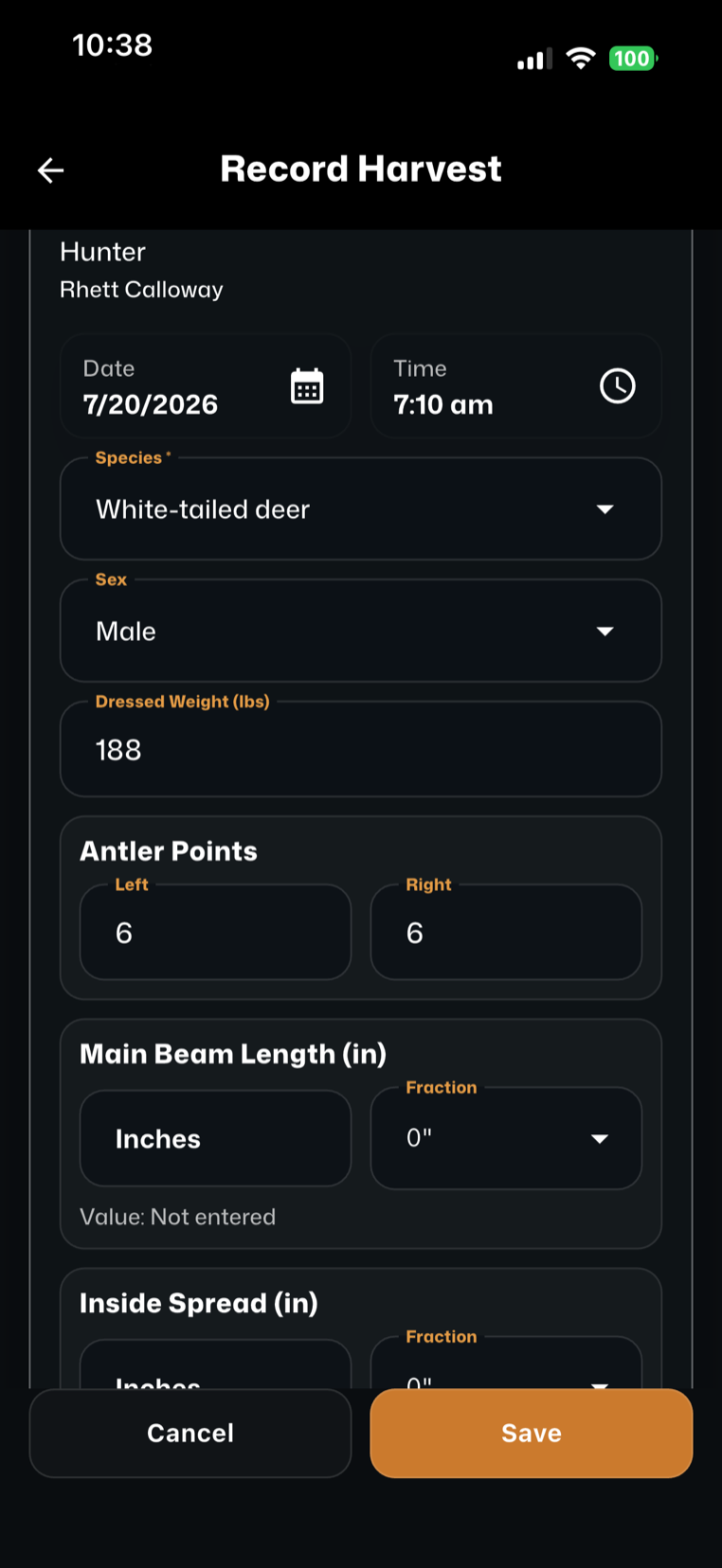
- 4. ShareThe hunter records the harvest in WildIndex with the appropriate property, animal details, location and photos. This is the companion record.
- 5. ReconcileDuring the season, the property admin compares digital entries with the official log and resolves omissions or mismatches. Complete TPWD’s LMA reporting by its deadline.
The reconciliation procedure is an organizational recommendation, not an additional TPWD requirement. A GPS point, photo or age estimate can add management context, but it is not proof of compliance or a verified population measure. The official log should remain legible and available to TPWD personnel on request.
05 / Digital companion
What WildIndex adds to the property record
WildIndex lets authorized hunters record a harvest against the property and lets administrators review the shared harvest history without waiting to return to the physical log. The app can preserve photos, species details, dates, hunter attribution and mapped field context. Those details can help a manager review season activity and compare it with other harvest records, the property-recording guide, and the broader management workflow.
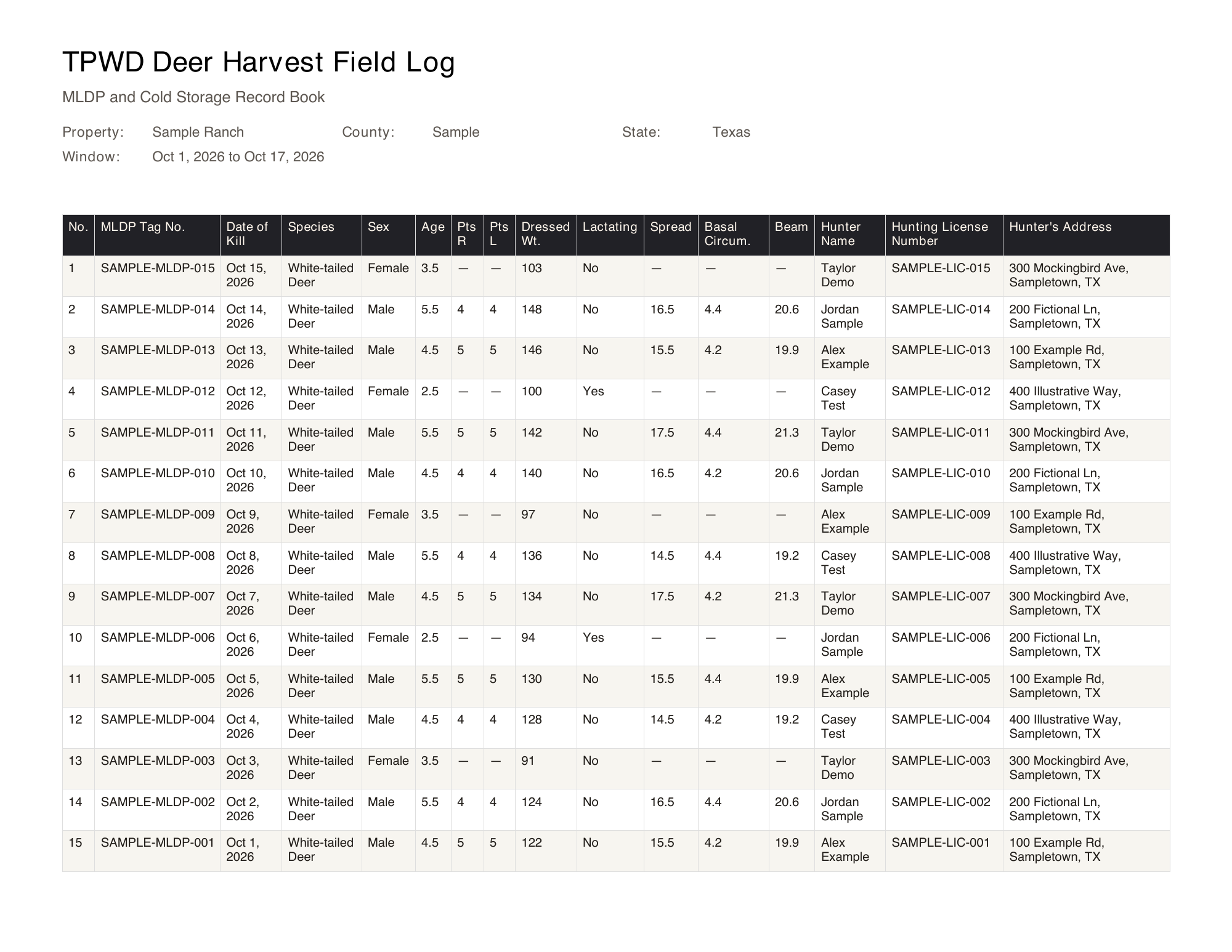
In WildIndex Web, the Reporting page can turn recorded Texas deer harvests into a field-log-style form that corresponds to the Texas MLDP deer harvest log. Managers can select a date range, generate the report, and download it as a PDF or CSV. The report brings together tag numbers, harvest dates, deer details, and hunter information entered in WildIndex.
The WildIndex report is not a TPWD-approved substitute for the required MLDP harvest log. Use it to cross-check dates, tag numbers and hunter details against the official record. It does not establish compliance on its own or submit information to LMA. Check that every required field appears correctly on the current TPWD form and in TPWD’s reporting system.
WildIndex Web / Reporting
See a generated MLDP-style report
This sample PDF was generated by WildIndex Web using fictional ranch, hunter, tag, and license information. It shows the companion report managers can use to review entries against the required MLDP form.
 View the full sample PDF
Common questions
Can a digital app replace the Texas MLDP harvest log?
Not automatically. TPWD requires the daily harvest log on a department-provided or approved form, maintained on the enrolled tract or qualifying aggregate acreage. WildIndex should be treated as a companion property record unless TPWD has approved its use as the official log. An app entry does not remove the same-day entry duty. Read §65.29 .
When are MLDP harvest totals due?
The participant must report the required buck and antlerless harvest totals to TPWD by April 1 each year of participation. TPWD currently directs participants to use LMA. Conservation Option properties also have other reporting duties. Check the current program instructions .
Should the manager wait until April to review harvests?
No. A midseason comparison between the official log and a companion record can reveal missing or inconsistent entries while the hunters remember the details. This review is a management practice, not a replacement for same-day official entries.
References
Sources & Further Reading
Reviewed October 25, 2026. Regulations, forms and program requirements can change. Confirm the current requirements with TPWD before relying on any recordkeeping workflow.
- Texas Parks and Wildlife Department. Managed Lands Deer Program overview and forms
- Texas Parks and Wildlife Department. MLDP Information: harvest log and program requirements
- Texas Parks and Wildlife Department. Deer Harvest Field Log (MLDP and Cold Storage Record Book) 2019 form, linked by TPWD.
- Texas Parks and Wildlife Department. After Harvesting a Deer or Pronghorn
- Texas Administrative Code. 31 TAC §65.29, Managed Lands Deer Program
- Texas Secretary of State. Current Texas Administrative Code portal
WildIndex in the field
Keep the official log compliant. Keep the property record connected.
Use the TPWD-required record for compliance and WildIndex for shared season visibility and long-term review.