


WildIndex Intelligence / Deer Management
How Hunting Pressure Changes Deer Movement—and What Managers Can Measure
A manager cannot interpret deer sightings well without knowing where, when, and how often people hunted.
By WildIndex Editorial Team · Published October 21, 2026 · Last reviewed October 21, 2026
Hunting pressure is a pattern of human activity, not simply the number of hunters on a property. An approach road used every morning, a frequently occupied stand, a vehicle stopping at a gate, and a neighboring property’s opening weekend can each change the conditions deer encounter. Research shows that deer can alter movement in response to hunting risk, but the response is not uniform across places, sexes, seasons, or methods. The practical question for a property manager is therefore specific: what happened to observed deer activity as hunter activity changed here?
01 / Behavioral response
Deer can respond to risk without leaving the property
In a controlled Oklahoma study of adult male white-tailed deer, Little and colleagues found that greater hunting intensity altered spatial and temporal movement behavior. The study supports a real response to risk. It does not say that every pressured deer becomes exclusively nocturnal, crosses the property line, or remains displaced for a fixed number of days.
Other studies give useful limits. Karns and colleagues followed a small sample of adult males in Maryland and did not find a simple increase in home-range size during hunting; reduced movement had potential seasonal confounding. A study of female deer in a low-pressure northern Georgia setting found no biologically significant movement response to firearms hunting under those conditions. Those results need not contradict the Oklahoma treatment study. Pressure intensity, habitat, refuge availability, the sex and age of deer, and the season differed.
A deer can remain within a familiar home range while shifting the timing, route, or cover it uses. It can also continue using a site while becoming less visible to a particular hunter. That distinction matters. A property record of sightings is an observation of the encounter between deer and observers; it is not a direct measurement of every animal’s location. To understand a change, record the human side of the encounter as carefully as the animal side.
02 / Human activity
Pressure is more than a hunter headcount
Two properties can host the same number of hunters and expose deer to very different patterns of disturbance. One may spread visits among accessible sites; another may drive a road through core cover at dawn and dusk. Record the location and timing of activity, routes used, vehicle movement, site occupancy, and repeated visits. These are potential exposure measures, not a single proven pressure score.
Think about the whole trip. Entry and exit can add scent, noise, and visible movement beyond the time spent in the stand. Checking cameras, filling a feeder where legal, working on a blind, or walking a trail can also add human presence. Whether deer respond to each event depends on context. Treating every visit as identical will hide the pattern a manager is trying to understand.
Intensity also varies around a property. A quiet parcel may be affected by access or harvest activity across a fence; a heavily used property may retain cover that functions as local refuge. Managers rarely have a complete map of neighboring activity, so note known events without pretending to quantify unknown ones. The aim is to make the pressure history more explicit, even when it remains incomplete.
Begin with a simple diary: date, hunter, hunt site, entry and exit times if available, route or gate, and any substantial non-hunting activity. Consistency is more important than an elaborate rating that no one maintains. The property-records guide describes a practical minimum dataset.
03 / Reading the signal
A lower sighting total is not a deer census
Suppose hunters report half as many sightings in the second week as in the first. The difference might reflect altered deer movement after repeated activity. It might also reflect fewer hunts, shorter sits, a switch to sites with poor visibility, a mast crop drawing deer away from an open field, or ordinary seasonal change. The count alone cannot identify the cause. A harvest total has similar limits: opportunity, regulations, hunter choice, and effort affect what is taken.
Record whether the property was observed at all during each period. A week with one hunter at one site should not be treated as equivalent to a week with six hunters covering multiple sites. Comparing sightings per period of comparable hunter activity can be more informative than comparing raw totals, although it still does not become a population estimate. The same caution applies when cameras are moved, checked at different intervals, or operated for different numbers of days.
Ask what alternative explanations could produce the pattern. Did food availability change? Was a road closed? Were hunts concentrated at a different time of day? Did a camera fail? Did other deer appear while a familiar animal disappeared? These questions turn an apparent conclusion into a set of testable property hypotheses. The early-season movement article covers food and weather context, while the camera guide explains detection effort.
When the stakes are a harvest objective or habitat decision, use appropriate wildlife survey methods and professional advice. Field logs can make those decisions better informed, but they do not replace a designed abundance survey.
04 / Comparable records
Track hunter effort alongside wildlife observations
A sighting is most useful when paired with who was present, where they were, and when they were there. Site, date, start and end times, and hunter identity are a workable core. Note a zero-sighting hunt as carefully as a successful one. Otherwise the record gradually becomes a collection of memorable encounters and hides the observation effort that produced them.
For example, ten sightings from a heavily used field stand may represent more observation effort than five sightings from a rarely used timber stand. Neither figure establishes that one habitat holds twice as many deer. Compare records within a similar season phase, time window, and observation setup where possible. When those conditions differ, describe the difference before drawing a management conclusion.
Record harvests separately from sightings and the hunt session. A harvest supplies important information about an individual animal and management action; it also removes that animal from future observations. The deer harvest tracking guide explains why harvest composition and effort belong together and why totals alone are not a herd count.
Over several seasons, a complete effort record can help answer sharper questions: Did sightings decline at a stand after repeated visits under comparable conditions? Did another site gain use as food changed? Was the apparent lull a week when fewer people hunted? Even an inconclusive answer is useful if it prevents an unsupported claim about herd decline.
For clubs with several hunters, agree on site names and the definition of a hunt session before the season begins. A two-hour evening sit and an all-day outing should not silently become identical entries. Record enough detail to explain differences, while keeping the form short enough that every hunter will use it. The most sophisticated analysis cannot recover outings that were never entered.
05 / Property decisions
Use refuge and rotation as hypotheses to evaluate
Managers often reserve some cover from routine entry and vary the use of hunt sites. This can reduce repeated human exposure in places where deer spend time, but no peer-reviewed result yields a universal “rest the stand for seven days” prescription. Property size, access, habitat, hunting objectives, and neighboring activity change what is possible. A site may be quiet on your map yet exposed from a shared boundary.
Map sensitive areas and the roads or routes needed to reach them. Decide in advance which activities are necessary and which can be consolidated. A camera check that can wait may avoid an extra trip; a safety repair cannot. If a site is rested, record the actual rest period and subsequent hunts rather than assuming a calendar rule caused a later sighting. One season’s apparent improvement can be coincidence or a food change.
It helps to maintain several safe stand options under different winds and access conditions. The site-selection guide treats wind, route, safety and evidence of use as one decision. A manager can then choose a site for the day without repeatedly entering the same cover. Review whether the planned rotation was actually followed; a written plan and field behavior often differ.
06 / How WildIndex helps
Make hunter presence visible in the property record
WildIndex brings Active Hunts, hunt sites, sightings, harvests and mapped field information into the shared property view. A manager can ask not only where deer were seen, but where hunters were present when those observations were made. Field Intel and the property history add context across hunts and seasons. The workflow is simple: record the hunt when it occurs, attach observations to place and time, then review the two histories together.
That does not prove why deer used one route or establish the property’s population. It reduces the amount of guesswork caused by missing effort records and scattered messages. Authorized hunters contribute to the same history, so a manager need not reconstruct the season from separate phones. A useful review still asks about changing food, cameras, conditions and known neighboring activity before attributing a change to pressure.
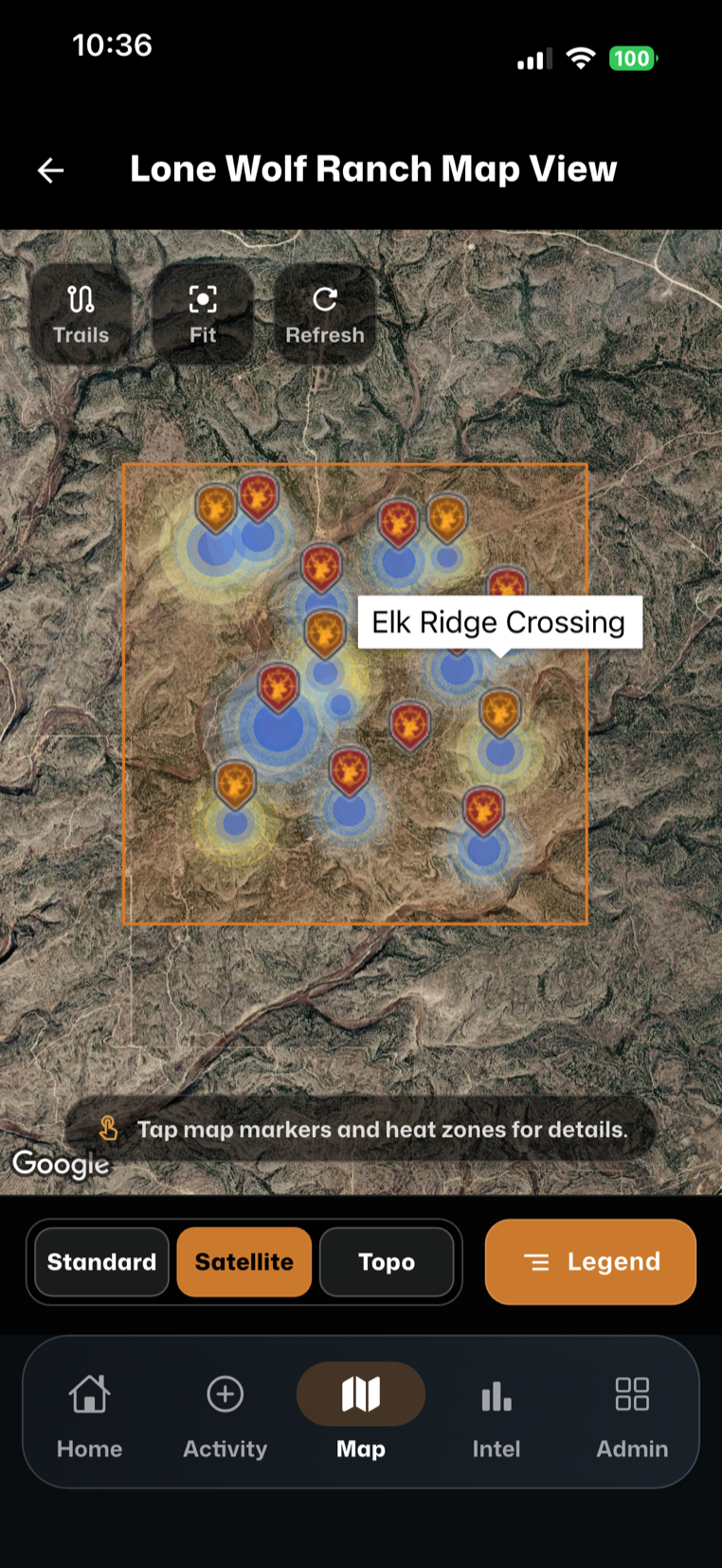
WildIndex’s Property Map makes site distribution visible. Review whether many hunts cluster along one access corridor and whether sightings shifted at the same time. Treat the map as a prompt for field investigation, not a causal diagram. Property management covers the larger process of turning those observations into an annual plan.
Practical questions
Common questions
Does hunting pressure make deer nocturnal?
Some deer can shift the timing of movement under hunting risk, but a universal shift to nocturnal activity is unsupported. The response depends on the study population, pressure, season and available cover.
How long does it take deer to return after disturbance?
There is no defensible universal recovery interval. Disturbance type, intensity, habitat, individual deer and continuing human activity all matter. Record visits and later observations rather than applying an arbitrary rest-day rule.
Do fewer sightings mean there are fewer deer?
No. Fewer sightings can also follow reduced hunter effort, changed location, food shifts, different visibility or behavioral change. A designed survey is needed for stronger population inference.
What should a hunting club record to assess pressure?
At minimum, record hunter, site, date, time window and whether deer were seen, including zero-sighting hunts. Add access route and major property activity when practical.
Can a refuge area help?
Limiting routine disturbance in selected cover may be a useful management choice, but its effect depends on the property and surrounding activity. Map it, document actual entry, and evaluate the resulting observations cautiously.
Can a camera prove deer left after a stand was hunted?
A camera can document detections at its location. A decline may reflect changed movement, placement, camera operation or other factors; it cannot prove that deer left the property.
References
Sources & Further Reading
This article draws on peer-reviewed wildlife research, university extension guidance, and agency management resources. Findings from one region or study design may not apply unchanged to another property.
- A. R. Little, S. L. Webb, S. Demarais, K. L. Gee, S. K. Riffell, and J. A. Gaskamp. Hunting intensity alters movement behaviour of white-tailed deer Basic and Applied Ecology 17(4):360–369. 2016. doi:10.1016/j.baae.2015.12.003.
- G. R. Karns, R. A. Lancia, C. S. DePerno, and M. C. Conner. Impact of Hunting Pressure on Adult Male White-tailed Deer Behavior Proceedings of the Annual Conference of the Southeastern Association of Fish and Wildlife Agencies 66:120–125. 2012.
- J. P. Rosenberger et al.. Female Deer Movements Relative to Firearms Hunting in Northern Georgia, USA Animals 14(8):1212. 2024. doi:10.3390/ani14081212.
- S. L. Webb, K. L. Gee, B. K. Strickland, S. Demarais, and R. W. DeYoung. Measuring Fine-Scale White-Tailed Deer Movements and Environmental Influences Using GPS Collars International Journal of Ecology. 2010. doi:10.1155/2010/459610.
- Texas Parks and Wildlife Department. Developing a Deer Management Plan TPWD technical guidance.
- University of Missouri Extension. Ecology and Management of White-Tailed Deer in Missouri
WildIndex in the field
Track the hunters as well as the wildlife.
Keep hunt participation, sites and wildlife observations in one property history so changes have the context they need.