


WildIndex Intelligence / Deer Management
Early-Season Deer Movement: Weather, Food, Pressure, and Time of Day
A useful early-season pattern is built from repeated observations on a particular property, not a single weather rule.
By WildIndex Editorial Team · Published October 21, 2026 · Last reviewed October 21, 2026
Before the rut, hunters often look for one reliable movement trigger: a cold front, a wind direction, a food source, or a particular hour. White-tailed deer respond to several conditions at once. Food and cover change through the season, people begin entering the property, and individual animals use different parts of the landscape. A field record is most useful when it preserves what was observed and how the observation was made.
01 / Baseline
Start with the daily rhythm, then look for exceptions
Crepuscular means most active around dawn and dusk. In a GPS-collar study of white-tailed deer on a southern Oklahoma property, Webb and colleagues found that crepuscular movement was a more consistent feature than fine-scale responses to the weather variables they examined. That result supports treating dawn and dusk as useful starting windows, not as the only times a deer can move.
Movement is not the same as visibility to a hunter. A deer can move under cover, beyond a camera’s detection zone, or at a site nobody hunts. Likewise, a morning with several sightings may reflect more hunter hours or clearer sight lines. When looking for an early-season pattern, first compare similar observation windows: the same site, similar daylight period, and similar effort.
The Oklahoma GPS study sampled a particular population and seasons; it did not define a universal timetable for every habitat or latitude. Local sunrise, vegetation, feeding areas, hunting access and individual behavior will shape what a property records. A manager should retain the actual time and location of each sighting, including observations outside the expected peak.
Distinguish daily activity from the time a hunter is most likely to observe it. An animal that walks inside thick cover at midday is moving even if no stand overlooks the route. Cameras also sample narrow views, and their clocks may drift. When reviewing timestamps, confirm the device time zone and whether daylight saving time was set correctly. Otherwise an apparent shift toward darkness may be a recordkeeping error rather than an animal response.
Season phase matters as well. The weeks called “early season” can span different forage, daylight and temperature conditions from one state to another. Compare a property’s first two weeks with the same local phase in prior years, noting opening dates and major changes in habitat. Do not pool an entire fall into one daily average and assume it describes the opening period.
02 / Conditions
Weather matters, but a front is not a universal switch
Temperature, wind and precipitation may affect deer movement, but they also change what hunters can see and how often hunters go out. A cooler day may prompt more people to hunt; strong wind may move vegetation and make an animal harder to hear; rain can obscure a camera image. Treat a change in sightings after a front as a question about both deer behavior and the observation process.
Webb et al. found inconsistent fine-scale weather effects within seasons in their Oklahoma study, while dawn and dusk patterns were clearer. That does not mean weather is irrelevant everywhere. It means claims such as “every cold front makes deer move more” go beyond this evidence. Conditions can influence energetic needs, comfort and habitat use differently by region and season, and the measurable effect may vary among animals.
Record temperature, wind and precipitation when available, but compare them within a meaningful season window. One unusually cold morning followed by a harvest is an event, not a measured relationship. A stronger property-level review would ask how many comparable hunts occurred under different conditions and where they took place.
A forecast front can also change decisions before it changes any deer behavior. Hunters may choose their best stands, stay longer, or enter an area they had avoided. If success improves after the front, those choices are competing explanations. A property log should retain hunter, site and time afield so the weather interpretation does not rest on a single dramatic harvest story.
Wind deserves similar care. It may affect scent transport, site choice and the route a hunter takes, while local terrain can make stand-level air flow differ from the weather station. A useful note is “southwest forecast, variable wind in creek bottom,” not simply a numeric wind value presented as a complete explanation for the sightings.
03 / Resource use
Changing food can reorganize where movement is visible
Early-season food availability is not static. Agricultural crops mature or are harvested; acorns begin to fall in some regions; native browse and forbs change with rain and temperature. A deer may use a different part of its familiar range as those resources change. The University of Missouri Extension describes how deer select foods according to local availability and season rather than following a fixed list of preferred crops.
In a Virginia study, McShea and Schwede observed radio-collared female deer expanding their home ranges to include acorn-producing areas during mast fall. That finding illustrates a mechanism, but its scale and timing should not be imposed on a southern ranch or a property without comparable oak habitat. A shift away from a camera at a field edge may be a redistribution of use rather than a decline in local deer numbers.
Map available foods and note when a resource changes. If a field is harvested, record the date. If a mast crop begins, note the area and rough timing. Feeders and food plots, where lawful, should be documented as part of the observation context because they can concentrate detections. The same applies to water and cover. The useful question is “What resources were available here during this observation period?” rather than “Which crop always works?”
Record what is present beyond a favorite food plot. A good mast crop in cover may pull activity away from an open field without requiring deer to travel far. Conversely, a dry period or local crop harvest may concentrate observations at a remaining resource. Walk the property to confirm the change. A camera at one feeding point cannot describe every food choice available to an animal.
The deer food-source guide separates native forage, planted plots and feeders so those changes can be interpreted in the right context.
04 / Disturbance
Hunting pressure changes the system being observed
Opening a season changes the property. Hunters drive roads, walk access routes, visit stands and check cameras. Deer may respond to that perceived risk. In an Oklahoma experiment, Little and colleagues found adult males altered spatial and temporal movement strategies under hunting treatments; the magnitude of change differed by treatment. A separate Maryland study of nine adult males found no home-range size change during a two-week firearms season and cautioned that seasonal timing complicated interpretation. Read Karns et al.
These findings do not establish a universal number of hunts after which a stand “burns out.” The response depends on access, cover, intensity, individual animals and when the study occurred. Repeated entries along a bedding edge may matter differently from quiet access to a site with multiple routes. Record the hunter, site and time window so an apparent drop in deer observations can be examined alongside the human activity that preceded it.
The hunting-pressure guide goes deeper into risk, hunter effort and why fewer sightings cannot be assigned to pressure without more context.
05 / Interpretation
Use the property’s history instead of a generic forecast
A regional weather forecast cannot describe exactly how deer will use one property. The more useful comparison is within the property: the same site across comparable weeks, repeated dawn or dusk observations, camera deployments with similar effort, and the number of people who were actually watching. The aim is to reduce guesswork, not to claim a precise prediction.
Suppose a food-plot camera records fewer early-evening deer after the first weekend. Before calling this a behavioral response, check whether the plot changed, whether the camera was moved, whether a second food source appeared, and whether hunters used a nearby access route. If several records agree, the manager has a stronger reason to investigate. If they conflict, the uncertainty is useful information.
A simple weekly review can keep observations and interpretations separate: list the sighting and camera events; list hunter outings and weather; note any habitat or access changes; then write the current hypothesis and what evidence would challenge it. The hunting-site guide uses those records when evaluating wind, access and site use.
Use negative evidence carefully. No sightings at a stand after three hunts says that those hunters did not see deer during those periods; it does not establish absence. If nearby cameras were functioning and observed activity later at night, the combined record may support a timing hypothesis. If the cameras were offline, the property has a gap in observation, not evidence that activity stopped.
06 / How WildIndex helps
Build a property-specific movement record
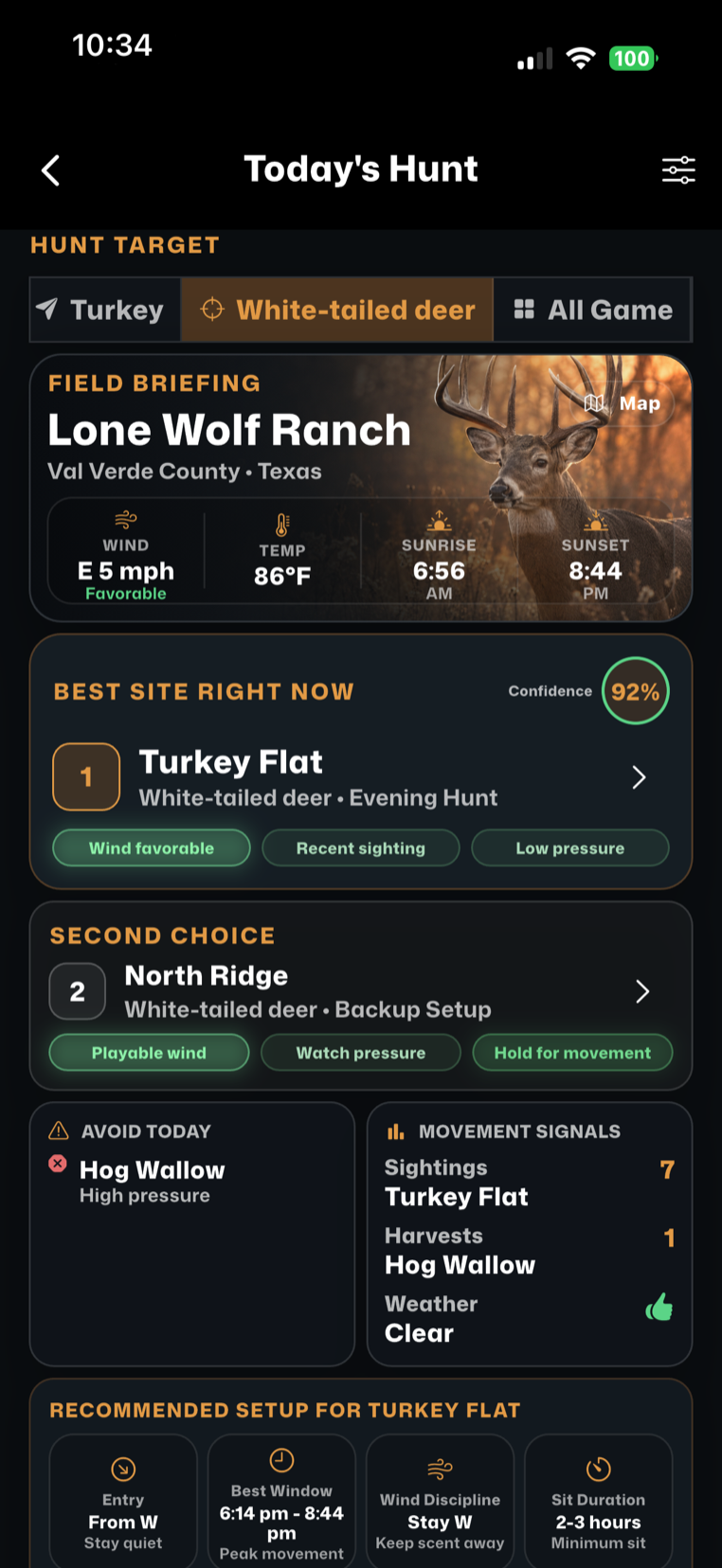
WildIndex can keep sightings, hunter attribution, time, hunt site and location in one property record. Today’s Hunt provides field conditions; Active Hunts and property activity show where the group was hunting; camera records and harvests add other observations. Those data can be reviewed together rather than reconstructed from separate messages after the season.
The practical benefit is comparison with more context. A manager can ask where deer were observed during similar periods and whether hunters or cameras were present to detect them. Weather is context, not an automatic explanation. WildIndex does not predict where deer will be with certainty or replace a biological survey. The property-records checklist describes the fields worth collecting consistently.
Practical questions
Common questions
What time do deer move most in early season?
Dawn and dusk are useful baseline periods, but deer move at other times. Local food, cover, disturbance and individual behavior can change what a hunter or camera observes.
Do cold fronts make deer move more?
There is no reliable rule that every front increases movement. The GPS-collar study cited above found inconsistent fine-scale weather effects in its southern study population. Compare multiple similar hunts on your own property.
Why did deer disappear from a food-plot camera?
They may have shifted to another food source, changed the timing of use, or passed outside the camera’s view. Check camera operation, competing food and hunter activity before inferring a population change.
Does early hunting pressure make deer nocturnal?
Some deer adjust movement under risk, but a universal shift to nocturnality is not supported. Response depends on pressure, cover, individual behavior and study setting.
How should I compare two early seasons?
Use the same weeks and sites where possible, retain camera nights and hunter outings, and note major changes in food, access and weather. Missing effort makes a sighting comparison difficult to interpret.
References
Sources & Further Reading
This article draws on peer-reviewed wildlife research, university extension guidance, and agency management resources. Findings from one region or study design may not apply unchanged to another property.
- S. L. Webb, K. L. Gee, B. K. Strickland, S. Demarais, and R. W. DeYoung. Measuring Fine-Scale White-Tailed Deer Movements and Environmental Influences Using GPS Collars International Journal of Ecology. 2010. doi:10.1155/2010/459610.
- A. R. Little, S. L. Webb, S. Demarais, K. L. Gee, S. K. Riffell, and J. A. Gaskamp. Hunting intensity alters movement behaviour of white-tailed deer Basic and Applied Ecology 17(4):360–369. 2016. doi:10.1016/j.baae.2015.12.003.
- G. R. Karns, R. A. Lancia, C. S. DePerno, and M. C. Conner. Impact of Hunting Pressure on Adult Male White-tailed Deer Behavior Proceedings of the Annual Conference of the Southeastern Association of Fish and Wildlife Agencies 66:120–125. 2012.
- W. J. McShea and G. Schwede. Variable Acorn Crops: Responses of White-Tailed Deer and Other Mast Consumers Journal of Mammalogy 74(4):999–1006. 1993. doi:10.2307/1382439.
- University of Missouri Extension. Ecology and Management of White-Tailed Deer in Missouri
- Texas Parks and Wildlife Department. Developing a Deer Management Plan TPWD technical guidance.
WildIndex in the field
Build your property’s movement history.
Keep sightings, hunt sites, time and field conditions together so next season’s questions begin with a record.